


Businesses today need advertising that doesn't just capture attention but converts viewers into customers. When you make video for advertisement campaigns, you're investing in the most powerful medium for driving measurable business results across digital platforms. Video advertising generates higher engagement rates, better recall, and stronger conversion metrics than static content, making it essential for brands competing in the Greater Toronto Area and beyond. This guide explores the strategic framework, production techniques, and platform-specific approaches that transform video content from mere visibility into revenue-generating assets.
Understanding Performance-Driven Video Advertising
The foundation of effective advertising video starts with clarity about business objectives. Before production begins, successful brands identify specific metrics they need to move, whether that's website traffic, lead generation, product sales, or brand awareness within targeted demographics.
Defining Campaign Goals and Success Metrics
Every advertising video should connect directly to quantifiable business outcomes. Start by establishing which stage of the customer journey you're targeting: awareness, consideration, or conversion. Each stage requires different creative approaches and messaging strategies.
Key metrics to establish before production:
- Cost per acquisition (CPA) targets
- Click-through rate (CTR) benchmarks
- View-through conversion rates
- Brand lift measurements
- Return on ad spend (ROAS) goals
When you create video for business applications, aligning creative decisions with these metrics ensures every production dollar contributes to measurable outcomes. Brands that define success parameters upfront typically achieve 40% better performance than those using generic creative approaches.

Platform-Specific Strategic Planning
Different advertising platforms demand tailored creative strategies. The video that performs exceptionally on Facebook may underdeliver on YouTube or LinkedIn. Understanding these distinctions before you make video for advertisement content prevents costly creative mismatches.
| Platform | Optimal Length | Primary Focus | Key Creative Element |
|---|---|---|---|
| 15-30 seconds | Mobile-first design | First 3-second hook | |
| 15 seconds | Vertical format | Visual storytelling | |
| YouTube | 15-60 seconds | Skippable ads | Value proposition clarity |
| 15-30 seconds | Professional tone | Business outcomes | |
| TikTok | 9-15 seconds | Native content feel | Authentic delivery |
According to platform-specific video advertising strategies, brands that customize creative for each channel see engagement rates increase by up to 300% compared to repurposed content.
Production Techniques That Drive Advertising Performance
Creating high-performance advertising video requires balancing creative impact with strategic messaging. The production approach you select directly influences viewer response and campaign economics.
Scripting for Attention and Conversion
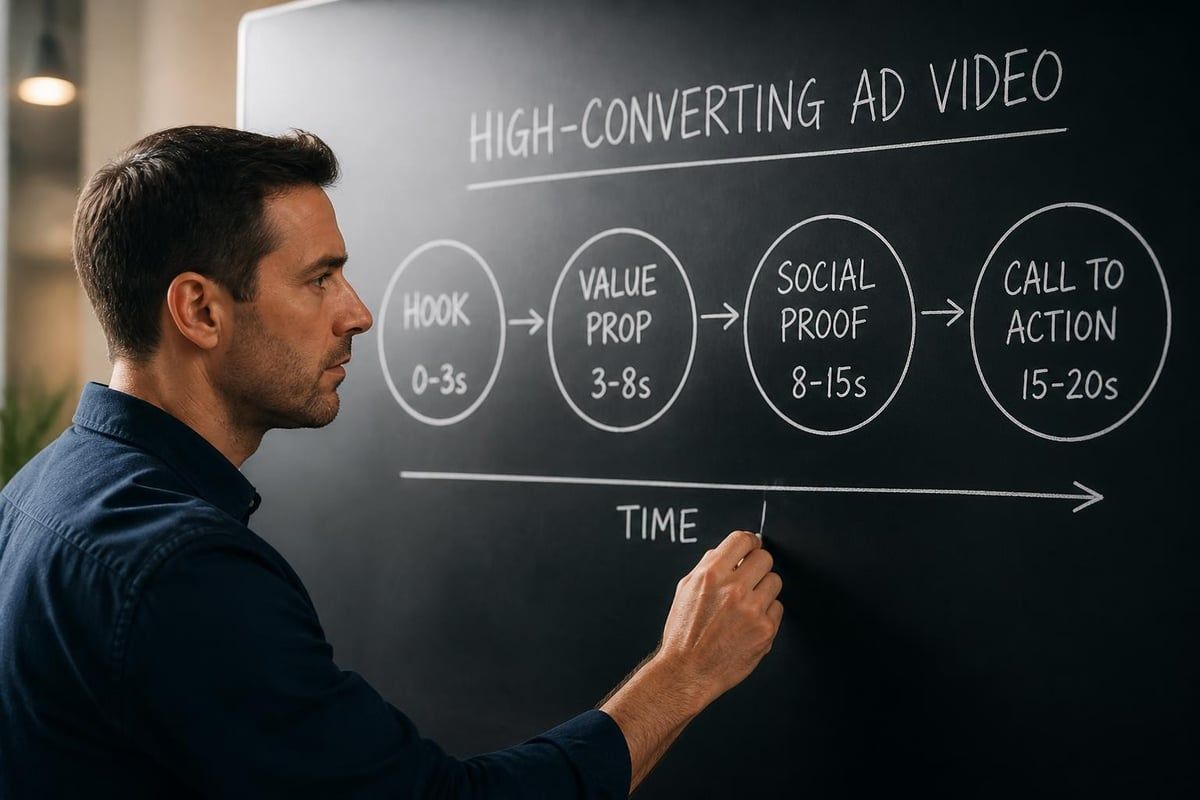
Effective advertising scripts operate on compressed timelines. You have 3 seconds to stop the scroll, 8 seconds to communicate value, and 15-30 seconds total to drive action. This demands precision in every word and visual element.
Essential script components:
- Immediate hook - Opens with pattern disruption or compelling question
- Value proposition - Clearly states benefit within first 5 seconds
- Social proof - Incorporates credibility signals or testimonials
- Clear CTA - Directs specific next action without ambiguity
The difference between commercial video production that converts and content that merely entertains lies in how tightly scripts connect features to customer benefits. Every frame should advance the viewer toward a decision.
Visual Design Optimized for Silent Viewing
Research indicates that 85% of social media video views occur with sound off. When you make video for advertisement distribution across social platforms, designing for silent consumption becomes critical.
Text overlays must communicate the core message independently of audio. Visual hierarchy guides viewers through key information points even without narration. Motion graphics reinforce messaging through kinetic typography and animated elements.
Bold graphic treatments, high-contrast visuals, and clear on-screen text ensure your message lands regardless of audio settings. Subtitles aren't optional - they're essential infrastructure for modern video advertising.
Production Value Versus Production Speed
The advertising landscape in 2026 rewards both quality and velocity. Brands need the production polish that builds credibility while maintaining the agility to test multiple creative variations rapidly.
Balancing quality and speed:
- Establish reusable templates for consistent brand presentation
- Create modular content blocks that allow rapid reassembly
- Invest in high-quality base footage that supports multiple edits
- Develop systematic approval workflows that prevent bottlenecks
Professional video production services understand this balance, delivering both the craftsmanship that elevates brand perception and the operational efficiency that supports iterative testing.
Strategic Creative Approaches for Maximum Impact
The creative strategy you employ when producing advertising video determines whether your content generates passive views or active customer engagement.
The First-Frame Hook Methodology
Viewers decide within the first second whether to continue watching. This makes the opening frame your most valuable creative real estate. Successful hooks employ pattern disruption, immediate value communication, or compelling visual intrigue.
Consider opening techniques that have demonstrated consistent performance:
- Direct question addressing viewer pain point
- Unexpected visual that creates cognitive dissonance
- Bold statement challenging common assumptions
- Dynamic motion that captures peripheral attention
- Recognizable face or spokesperson creating immediate connection
The vertical video advertising format particularly demands strong first-frame execution, as mobile viewers scroll past content that doesn't immediately justify their attention investment.
Emotional Resonance Versus Rational Messaging
The most effective advertising video balances emotional connection with rational justification. Emotion initiates engagement, while logic provides the permission structure for decision-making.
Emotional drivers that enhance advertising performance:
- Aspiration (showing desired future state)
- Relief (solving specific frustration)
- Belonging (community or identity connection)
- Achievement (capability or success enablement)
Layer these emotional foundations with concrete evidence: specific results, measurable outcomes, or credible third-party validation. This combination moves viewers from interest to action more effectively than either approach alone.
Testing Frameworks for Creative Optimization
When you make video for advertisement deployment, treating creative as hypothesis rather than final product enables continuous improvement. Systematic testing reveals which elements drive performance and which require refinement.
| Test Variable | Impact Level | Testing Priority |
|---|---|---|
| Opening hook | High | Essential |
| Value proposition clarity | High | Essential |
| CTA placement | Medium | Important |
| Music/sound design | Medium | Important |
| Video length | Medium | Important |
| Color grading | Low | Optional |
Implement structured A/B testing that isolates variables, runs statistically significant sample sizes, and documents learnings for future campaigns. According to video advertising optimization best practices, brands that test systematically achieve ROAS improvements of 150-200% over 90-day periods.
Platform Distribution and Optimization Strategies
Creating exceptional advertising video represents only half the equation. Strategic distribution amplifies performance through platform-specific optimization and audience targeting precision.
Native Advertising Integration Techniques
Native video advertising seamlessly integrates with platform design and user experience, generating 60% higher engagement than overtly promotional content. This approach requires understanding each platform's content norms and viewer expectations.
When distributing advertising video natively, match the visual style, pacing, and tone of organic content on that platform. TikTok advertising should feel like TikTok content. LinkedIn advertising should maintain professional production values aligned with platform standards.
This doesn't mean sacrificing brand identity - it means expressing that identity through each platform's native language. The most successful campaigns maintain consistent brand messaging while adapting creative execution to platform context.
Audience Segmentation for Creative Customization
Generic advertising underperforms across all platforms. Strategic segmentation allows you to deliver tailored messages to specific audience groups, dramatically improving relevance and response rates.
Effective segmentation dimensions:
- Demographic - Age, location, income level
- Psychographic - Values, interests, lifestyle
- Behavioral - Purchase history, engagement patterns
- Stage awareness - Problem unaware to product aware
Create video variations addressing each segment's specific concerns, language preferences, and decision drivers. This targeted approach, when you make video for advertisement distribution, increases conversion rates while reducing cost per acquisition.
Retargeting Strategies Using Video Assets
Video advertising achieves peak performance when integrated into comprehensive retargeting funnels. Viewers who engaged with initial awareness content receive consideration-stage messaging, while those who visited product pages see conversion-focused creative.
This sequential approach builds cumulative impact:
- Awareness video introduces brand and core value proposition
- Consideration video addresses specific benefits and differentiators
- Conversion video provides final proof points and compelling offers
Animated corporate video production particularly excels in retargeting scenarios, as animation enables rapid customization for different audience segments without expensive reshoots.
Technical Specifications and Quality Standards
Professional advertising video requires attention to technical specifications that ensure optimal performance across devices and platforms.
Format and Resolution Requirements
Each advertising platform maintains specific technical requirements for uploaded video assets. Failing to meet these specifications results in degraded quality, rejected uploads, or suboptimal delivery.
Standard technical specifications for 2026:
- Resolution: Minimum 1080p (1920x1080), 4K recommended for premium placements
- Aspect ratios: 16:9 (landscape), 1:1 (square), 9:16 (vertical)
- Frame rate: 30fps standard, 60fps for motion-intensive content
- File format: MP4 with H.264 compression
- Audio: AAC codec, 128kbps minimum bitrate
Understanding these requirements when you make video for advertisement ensures your content displays properly regardless of device or connection speed. Mobile optimization particularly demands attention to file size and loading performance.
Accessibility and Inclusive Design
Professional advertising video incorporates accessibility features that expand reach while demonstrating brand values. Subtitles, audio descriptions, and high-contrast visuals ensure your message reaches all potential customers.
Accessibility checklist:
- Burned-in subtitles or closed caption files
- Sufficient color contrast for text legibility
- Clear visual communication independent of audio
- Readable text sizing for mobile viewing
- Inclusive casting and representation
These elements don't just serve ethical imperatives - they measurably expand audience reach and improve engagement metrics across all demographic groups.
Budget Optimization and Resource Allocation
Smart budget allocation maximizes advertising video ROI by investing resources where they generate the greatest performance impact.
Production Investment Versus Distribution Spend
The optimal budget split between video production and media distribution depends on campaign objectives, competitive intensity, and available creative assets. Many brands overspend on production while underfunding distribution, limiting reach despite high-quality creative.
| Campaign Type | Production % | Distribution % | Rationale |
|---|---|---|---|
| Brand awareness | 30% | 70% | Maximize reach |
| Product launch | 40% | 60% | Balance quality and reach |
| Direct response | 25% | 75% | Prioritize conversion volume |
| Thought leadership | 45% | 55% | Production quality signals authority |
According to research on video advertising strategy differences, successful campaigns typically allocate 25-40% to production and 60-75% to strategic distribution and testing.
Leveraging Existing Assets for Multiple Applications
When you make video for advertisement purposes, design production workflows that generate reusable assets. A single production day can yield master content plus derivative assets for multiple platforms and purposes.
Asset maximization strategies:
- Shoot additional B-roll for future editing flexibility
- Capture multiple aspect ratios simultaneously
- Record various CTA versions for testing
- Produce both long-form and cut-down versions
- Extract still images for complementary static ads
This approach delivers 3-5x more usable content per production dollar invested, dramatically improving overall campaign economics.
Measuring True ROI Beyond Vanity Metrics
Effective measurement focuses on business outcomes rather than engagement statistics. Views and likes indicate reach but don't confirm revenue impact. When evaluating advertising video performance, connect creative directly to conversions and customer value.
Priority metrics for ROI evaluation:
- Customer acquisition cost (CAC)
- Conversion rate by traffic source
- Average order value from video traffic
- Customer lifetime value (LTV)
- Return on ad spend (ROAS)
Professional video production services establish measurement frameworks before production begins, ensuring all creative decisions support trackable business objectives rather than subjective aesthetic preferences.

Advanced Tactics for Competitive Advantage
Sophisticated advertisers employ advanced techniques that create meaningful performance differentiation in crowded markets.
Dynamic Creative Optimization
Dynamic creative optimization (DCO) automatically assembles video components based on viewer characteristics and behavior. This technology enables truly personalized advertising at scale, delivering relevant messaging to thousands of micro-segments.
DCO systems combine modular video elements - different hooks, value propositions, product showcases, and CTAs - based on real-time data about each viewer. This approach increases relevance while reducing creative production overhead.
User-Generated Content Integration
Authentic customer testimonials and user-generated content (UGC) consistently outperform polished brand messaging in direct response campaigns. When you make video for advertisement that incorporates real customer experiences, you build credibility that scripted content cannot match.
Strategic UGC integration maintains production quality while leveraging authenticity:
- Professional editing of customer-shot footage
- Structured interview frameworks ensuring message consistency
- Quality control standards for technical specifications
- Legal frameworks protecting both brand and contributors
Successful case studies in video advertising demonstrate how brands combine professional production values with authentic customer voices to achieve exceptional performance metrics.
Sequential Storytelling Across Campaign Arcs
Rather than treating each advertisement as isolated, sequential campaigns build narrative arcs that deepen engagement over time. Viewers receive installments of an ongoing story, creating anticipation and stronger brand connection.
This approach works particularly well for:
- Product launches requiring education before purchase consideration
- Complex services needing multi-touchpoint explanation
- Brand building campaigns establishing market position
- Seasonal promotions maintaining momentum across weeks or months
Sequential storytelling transforms advertising from interruption into anticipated content, fundamentally changing the viewer relationship with your brand message.
Creative Excellence Meeting Strategic Performance
The intersection of creative brilliance and strategic rigor produces advertising video that both captivates audiences and drives measurable business results. When you make video for advertisement that honors both dimensions, you create assets that justify investment through documented ROI.
Understanding best practices for Facebook video advertising alongside platform-agnostic creative principles ensures your content performs across the full digital advertising ecosystem. This comprehensive approach separates campaigns that generate visibility from those that generate revenue.
Strategic video advertising in 2026 demands more than technical competence. It requires deep understanding of platform dynamics, audience psychology, creative testing methodologies, and the production techniques that deliver both impact and efficiency. Brands that master this combination transform advertising from cost center into growth engine.
The Greater Toronto Area's competitive business environment particularly rewards video advertising excellence. Local and regional brands compete for attention against national and international players, making creative differentiation and performance optimization essential for market success. Companies that invest in strategic video production gain sustainable competitive advantages through superior customer engagement and conversion efficiency.
Strategic advertising video represents one of the most powerful tools available to businesses seeking measurable growth in competitive markets. By combining creative excellence with rigorous performance optimization, brands transform video from expense into revenue driver. Viva Media specializes in creating high-performance advertising video that delivers documented business results for forward-thinking brands throughout the Greater Toronto Area. Whether you need commercial content, corporate messaging, or social media advertising, our team engineers attention-grabbing experiences that connect creative impact with measurable ROI.