


Video content has transformed from a nice-to-have marketing asset into an essential business tool that drives measurable results across every social platform. Brands that embrace video social media marketing gain competitive advantages through higher engagement rates, improved conversion metrics, and stronger audience connections. As we navigate 2026, the landscape continues to evolve with new platform features, changing algorithm preferences, and shifting consumer behaviors that demand strategic approaches to video content creation and distribution.
The Business Case for Video Social Media Marketing
The numbers tell a compelling story about why businesses must prioritize video content in their social strategies. According to comprehensive video marketing statistics for 2026, video content generates significantly higher engagement rates compared to static images or text-based posts across all major platforms.
Consumer behavior has shifted dramatically:
- Social video platforms now account for 20% of all TV viewing time, demonstrating how audiences have fundamentally changed their media consumption habits
- Users retain 95% of a message when delivered through video compared to just 10% when reading text
- Video posts generate 48% more views than other content types on business pages
The ROI metrics speak equally clearly. Businesses using video social media marketing report measurable improvements in brand awareness, lead generation, and direct sales conversions. The integration of shoppable video features across platforms has created direct pathways from content consumption to purchase decisions.
Platform-Specific Performance Indicators
Different platforms deliver distinct advantages for video marketers. Instagram Reels and TikTok excel at reaching younger demographics with short-form content, while LinkedIn video performs exceptionally well for B2B communications and thought leadership positioning.
| Platform | Optimal Video Length | Best Engagement Time | Primary Audience |
|---|---|---|---|
| Instagram Reels | 15-30 seconds | 11 AM - 1 PM EST | 18-34 years |
| TikTok | 21-34 seconds | 7-9 PM EST | 16-30 years |
| 30-90 seconds | 8-10 AM EST | 25-55 years | |
| 60-90 seconds | 1-3 PM EST | 25-65 years | |
| YouTube Shorts | 15-60 seconds | 2-4 PM EST | 18-49 years |
Understanding these platform nuances allows businesses to optimize their video social media marketing efforts for maximum impact. Working with a specialized social media video agency ensures content meets platform-specific requirements while maintaining brand consistency.

Strategic Planning for Video Content
Successful video social media marketing begins with comprehensive strategic planning that aligns content creation with business objectives. Random posting without strategic direction wastes resources and produces minimal results.
Essential planning components include:
- Audience research and persona development - Understanding who watches your content and what motivates their engagement
- Content calendar creation - Mapping video releases to business cycles, product launches, and seasonal trends
- Platform selection strategy - Choosing which channels deserve primary focus based on audience presence
- Production resource allocation - Determining in-house versus outsourced production capacity
- Performance measurement frameworks - Establishing KPIs before content creation begins
The eight-step strategy for successful social media video marketing provides a proven framework that businesses can adapt to their specific circumstances. This structured approach reduces wasted effort and accelerates results.
Content Format Diversification
Video social media marketing encompasses multiple content formats, each serving distinct purposes within your overall strategy. Educational tutorials build authority and trust, behind-the-scenes content humanizes your brand, customer testimonials provide social proof, and product demonstrations drive purchase decisions.
Short-form vertical video has emerged as the dominant format across platforms. Understanding creative videos that capture attention within the critical first three seconds determines whether your content gets watched or scrolled past.
The popularity of short-form content continues moving beyond traditional social media, creating opportunities for businesses to repurpose social video content across owned properties and distribution channels.
Technical Specifications and Production Quality
Professional video social media marketing requires adherence to platform-specific technical requirements that ensure optimal display and performance. Content uploaded with incorrect specifications faces reduced quality, cropping issues, or algorithm suppression.
The comprehensive social media video specs guide provides current technical requirements across all major platforms. These specifications change periodically as platforms update their systems, making ongoing education essential.
Critical technical considerations:
- Resolution standards - Most platforms now support 1080p as the minimum acceptable quality
- Aspect ratio variations - Square (1:1), vertical (9:16), and horizontal (16:9) formats serve different placement opportunities
- File size limitations - Compression must balance quality with upload restrictions
- Frame rate requirements - 30fps minimum, with 60fps preferred for motion-heavy content
- Audio specifications - Proper audio levels and format compatibility prevent playback issues
Production quality directly impacts performance metrics. Low-quality video suggests low-quality products or services, damaging brand perception regardless of actual business excellence. Partnering with professional video production services ensures content meets technical standards while delivering creative excellence.
Equipment and Software Selection
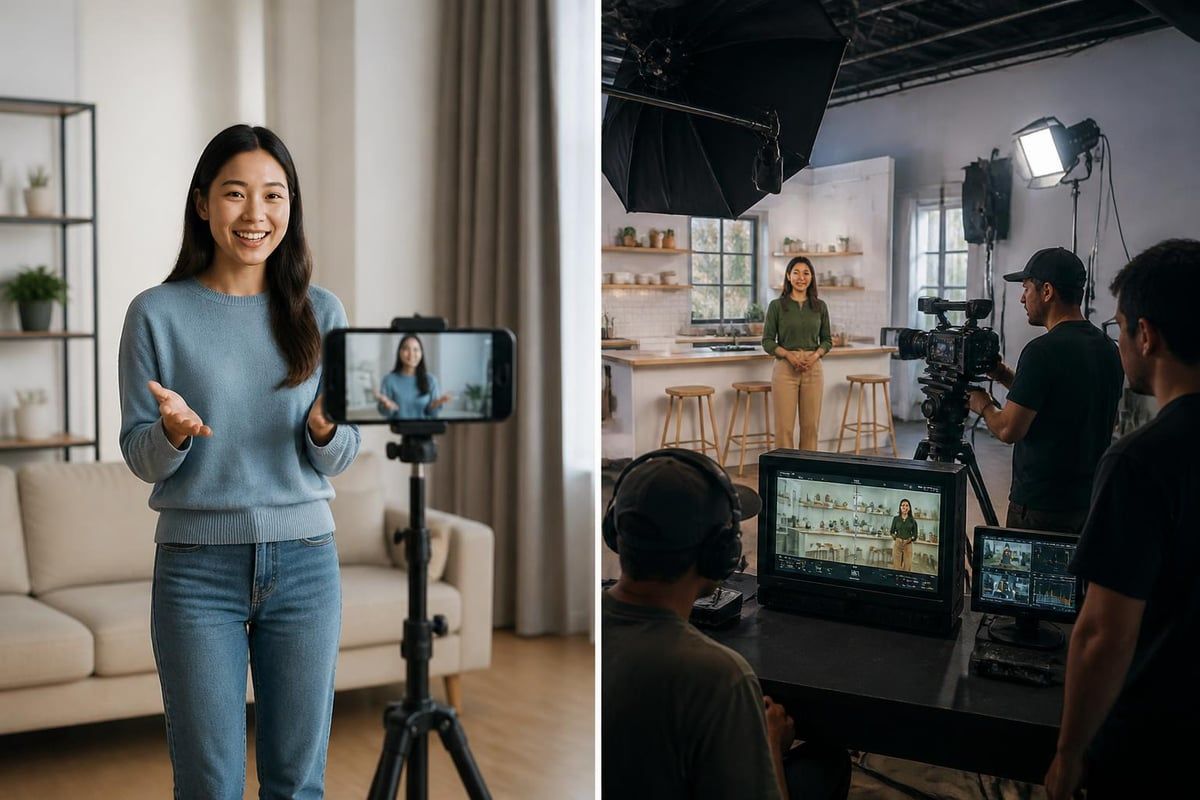
Businesses face decisions about production equipment investments versus outsourcing to professional production companies. Entry-level smartphone cameras can produce acceptable content for certain applications, but professional commercial work demands cinema-quality equipment, lighting, and sound recording.
Software selection impacts editing efficiency and output quality. Professional-grade tools provide advanced color correction, audio mixing, and effects capabilities that elevate final products above amateur content flooding social feeds.
Algorithm Optimization and Distribution Strategy
Creating exceptional video content represents only half the battle in video social media marketing. Distribution strategy and algorithm optimization determine whether your content reaches intended audiences or disappears into the void of unviewed posts.
Social media algorithms prioritize content that generates strong engagement signals within the first hour after posting. Videos that immediately capture viewer attention and inspire likes, comments, shares, and saves receive exponential reach amplification through algorithmic promotion.
Engagement Triggers and Retention Metrics
Platforms measure multiple engagement signals when determining content distribution:
- Watch time percentage - How much of your video viewers actually watch
- Completion rate - The percentage of viewers who watch until the end
- Interaction velocity - How quickly engagement accumulates after posting
- Share frequency - How often viewers send your content to others
- Save rate - When users bookmark content for later reference
Understanding video length best practices helps optimize for platform-specific retention benchmarks. Shorter videos naturally achieve higher completion rates, but longer content that maintains engagement demonstrates exceptional quality to algorithms.
The research on elements every viral video needs reveals patterns in content that achieves algorithmic amplification. While virality cannot be guaranteed, incorporating proven elements increases distribution potential.
Content Hooks and Storytelling Techniques
The first three seconds of any video determine its success or failure in video social media marketing. Viewers scrolling feeds make instantaneous decisions about whether content deserves their attention.
Effective opening hooks include:
- Pattern interrupts that stop scrolling behavior
- Provocative questions that create curiosity gaps
- Bold statements that challenge conventional thinking
- Visual surprises that demand closer inspection
- Immediate value propositions that promise benefits
Once you've captured initial attention, storytelling structure maintains engagement through the video's duration. The classic story arc of setup, conflict, and resolution works effectively even in 30-second formats. Emotional resonance creates stronger memory encoding and sharing motivation than purely informational content.
| Storytelling Element | Purpose | Implementation |
|---|---|---|
| Hook | Stop scrolling | First 3 seconds |
| Context | Establish relevance | Seconds 4-8 |
| Value Delivery | Provide benefit | Middle section |
| Call-to-Action | Direct next step | Final 5 seconds |
Professional scriptwriting transforms mediocre concepts into compelling narratives that drive measurable business results. Investing in quality pre-production planning delivers returns throughout the content lifecycle.
Emotional Connection Strategies
Video social media marketing succeeds when it creates authentic emotional connections with audiences. Corporate content that feels overly polished or sales-focused generates lower engagement than authentic, human-centered storytelling.
Behind-the-scenes content, employee spotlights, customer success stories, and transparent business communications build the trust necessary for long-term customer relationships. Brands that show vulnerability and authenticity develop stronger audience loyalty than those projecting artificial perfection.

Paid Promotion and Organic Reach Integration
Organic reach on social platforms has declined steadily as platforms prioritize paid advertising revenue. Successful video social media marketing in 2026 requires strategic integration of organic content and paid promotion to achieve business objectives.
Paid promotion amplifies exceptional content to targeted audiences beyond organic follower bases. The most effective approach involves testing content organically first, identifying top performers through engagement metrics, then allocating advertising budgets to amplify proven winners.
Paid promotion advantages:
- Precise demographic targeting beyond follower audiences
- Retargeting capabilities for remarketing to engaged viewers
- Guaranteed reach regardless of algorithm changes
- A/B testing opportunities for creative optimization
- Detailed attribution tracking for ROI measurement
Budget allocation depends on business objectives and competitive landscape. Companies in highly competitive markets require larger advertising investments to achieve visibility, while businesses in niche markets may achieve objectives through primarily organic strategies supplemented with modest paid promotion.
Testing and Optimization Frameworks
Continuous testing drives improvement in video social media marketing performance. Variables to test include video length, opening hooks, calls-to-action, posting times, caption copy, thumbnail images, and audience targeting parameters.
Statistical significance requires adequate sample sizes before drawing conclusions. Running tests too briefly or with insufficient reach produces unreliable data that leads to poor strategic decisions. Partnering with experienced advertising video production companies provides access to testing expertise developed across hundreds of campaigns.
Performance Measurement and Analytics
Data-driven decision making separates successful video social media marketing from wasteful content creation. Measuring the right metrics and interpreting results correctly enables continuous improvement and resource optimization.
Vanity metrics like view counts provide limited actionable insight. Views indicate reach but not engagement quality or business impact. More valuable metrics include:
- Engagement rate - Total interactions divided by impressions
- Click-through rate - Percentage of viewers taking desired actions
- Conversion rate - Viewers who complete business objectives
- Cost per acquisition - Investment required per customer gained
- Customer lifetime value - Long-term revenue per customer acquired through video
According to research showing that half of all U.S. consumers say social media is their primary way to learn about brands, video content directly impacts purchase decisions and brand discovery. Measuring attribution throughout the customer journey reveals video's true business impact.
Attribution Modeling Challenges
Multi-touch attribution remains challenging in video social media marketing because customer journeys involve multiple touchpoints across platforms. A customer might discover your brand through an Instagram Reel, research on YouTube, engage with LinkedIn content, then convert through a Facebook ad.
| Attribution Model | Strengths | Limitations |
|---|---|---|
| First-touch | Shows initial discovery | Ignores nurturing impact |
| Last-touch | Credits conversion driver | Misses awareness builders |
| Multi-touch | Distributes credit | Complex implementation |
| Time-decay | Values recent interactions | May undervalue early touchpoints |
Sophisticated analytics platforms provide multi-touch attribution insights that reveal how video content contributes throughout customer journeys. These insights inform budget allocation and content strategy optimization.
Resource Allocation and Production Efficiency
Businesses must balance video social media marketing ambitions against available resources. Production capacity constraints limit content volume, while budget restrictions affect production quality and paid promotion capabilities.
Strategic resource allocation focuses investments on highest-impact activities. Creating one exceptional video per week outperforms daily mediocre content that fails to engage audiences. Quality consistently beats quantity in algorithm performance and audience response.
Production efficiency strategies include:
- Batch filming multiple videos in single production sessions
- Repurposing long-form content into multiple short-form pieces
- Creating modular content templates that reduce per-video production time
- Building reusable asset libraries of b-roll footage and motion graphics
- Establishing clear brand guidelines that streamline creative decisions
Understanding video pricing structures helps businesses budget appropriately for professional production versus attempting in-house creation beyond their capabilities. The cost difference between amateur and professional production often delivers returns that justify the investment through superior performance.
In-House Versus Outsourced Production
Businesses face strategic decisions about building internal video production capabilities versus outsourcing to specialized agencies. Internal teams offer greater control and potentially lower per-video costs at scale, but require significant capital investment in equipment, software, and talent.
Outsourcing provides access to professional expertise, advanced equipment, and creative diversity without capital investments or fixed overhead. Many businesses find hybrid approaches optimal, handling simple content internally while outsourcing complex productions requiring specialized skills.
Companies serving the Greater Toronto Area can leverage local expertise from Toronto-based video production specialists who understand regional market dynamics and audience preferences.
Platform-Specific Strategy Development
While core video social media marketing principles apply across platforms, each channel requires tailored approaches that respect platform culture and user expectations. Content that succeeds on LinkedIn often fails on TikTok, and vice versa.
Platform-specific considerations:
- Instagram - Prioritize aesthetic quality and aspirational content
- TikTok - Embrace trends, authenticity, and entertainment value
- LinkedIn - Focus on professional development and industry insights
- Facebook - Target broader demographics with varied content types
- YouTube - Invest in longer-form educational and entertainment content
The extensive social media video statistics reveal platform-specific performance benchmarks that inform realistic goal setting. Understanding what constitutes strong performance on each platform prevents unrealistic expectations and strategic missteps.
Cross-posting identical content across platforms represents a missed optimization opportunity. While core messages may remain consistent, presentation style, video length, caption approach, and calls-to-action should reflect platform-specific best practices.
Emerging Platform Opportunities
New platforms and features create first-mover advantages for brands willing to experiment before saturation occurs. Early adopters on TikTok gained enormous organic reach before competition intensified and algorithms tightened.
Monitoring emerging trends and platform launches allows businesses to capitalize on opportunities before they become crowded. However, spreading resources too thin across every new platform dilutes impact. Strategic selectivity based on audience presence and business objectives guides smart platform expansion decisions.
Content Calendar Management and Consistency
Consistent publishing schedules build audience expectations and algorithm favor in video social media marketing. Sporadic posting confuses audiences and signals lower value to platform algorithms that reward reliability.
Content calendars provide structure while allowing flexibility for timely, responsive content. Planning 70-80% of content in advance leaves capacity for trending topics and reactive opportunities without sacrificing strategic consistency.
Calendar planning benefits include:
- Strategic alignment between content and business objectives
- Efficient resource utilization through advance planning
- Balanced content mix across educational, entertaining, and promotional videos
- Coordinated campaigns across multiple platforms
- Reduced last-minute production stress and quality compromises
Quarterly planning sessions establish strategic direction, monthly reviews adjust tactics based on performance data, and weekly check-ins ensure execution stays on track. This multi-level planning approach balances strategic vision with tactical flexibility.
Video social media marketing delivers measurable business results when executed with strategic planning, professional production quality, and data-driven optimization. The convergence of changing consumer behaviors, algorithm evolution, and platform innovation creates both challenges and opportunities for brands committed to video excellence. Viva Media partners with forward-thinking Toronto businesses to create high-performance video content that cuts through noise, captures attention, and converts viewers into customers through proven strategies backed by measurable results.