

The digital advertising landscape continues to evolve at breakneck speed, and understanding where your video content appears has never been more critical for business success. Google Video Partners represents a powerful extension of YouTube's advertising ecosystem, allowing brands to extend their reach far beyond the platform's native environment. For businesses investing in professional video production, understanding this network offers opportunities to maximize advertising spend and connect with audiences in unexpected places. As video consumption patterns fragment across countless platforms, the google video partner network provides advertisers with scale, targeting precision, and the ability to meet viewers wherever they consume content.
Understanding the Google Video Partners Network
The google video partner ecosystem functions as an extension of Google's video advertising capabilities, distributing video ads across a curated network of websites, apps, and connected TV platforms beyond YouTube itself. This network includes premium publishers and platforms that meet Google's quality standards for content and viewability.
What Qualifies as a Google Video Partner
Partner sites must meet stringent requirements regarding content quality, brand safety, and technical specifications. Publishers undergo rigorous vetting processes to ensure they align with advertiser expectations and Google's policies. The network encompasses news sites, entertainment platforms, gaming apps, and streaming services that collectively reach billions of users monthly.
Key qualification criteria include:
- Compliance with Google's Publisher Policies
- Meeting viewability and verification standards
- Implementing proper ad formats and player specifications
- Maintaining high-quality, brand-safe content environments
- Demonstrating substantial user engagement metrics
Google regularly evaluates partner performance and removes sites that fail to maintain standards. According to transparency initiatives from Google, the company has implemented enhanced measures to ensure brand safety and provide advertisers with greater control over where their ads appear.

Network Reach and Scale Advantages
The google video partner network dramatically expands campaign reach beyond YouTube's already massive audience. Advertisers can access incremental viewers who may not regularly engage with YouTube but consume video content on other platforms throughout their day.
This extended reach proves particularly valuable for businesses creating commercial video content designed to achieve specific conversion goals. The network's scale allows for efficient frequency management, ensuring viewers see your message without experiencing ad fatigue on a single platform.
| Advantage | YouTube Only | With Google Video Partners |
|---|---|---|
| Potential Reach | 2.5B+ users | 3B+ users globally |
| Platform Diversity | Single platform | Thousands of sites/apps |
| Audience Overlap | N/A | Incremental reach potential |
| CPM Efficiency | Standard rates | Often lower average CPM |
Strategic Benefits for Video Advertisers
Leveraging the google video partner network offers distinct advantages that complement YouTube-focused campaigns. Understanding these benefits helps advertisers make informed decisions about budget allocation and campaign structure.
Enhanced Targeting Capabilities
The network inherits Google's sophisticated audience targeting infrastructure, allowing advertisers to reach users based on demographics, interests, behaviors, and intent signals. This precision targeting ensures your professionally produced video content reaches viewers most likely to engage with your brand.
Available targeting options include:
- Demographic targeting based on age, gender, parental status, and household income
- Affinity audiences that group users by long-term interests and habits
- In-market audiences actively researching or considering purchases in specific categories
- Custom intent audiences built from keywords and URLs relevant to your business
- Remarketing lists that reconnect with users who previously engaged with your brand
For companies investing in professional video production services, these targeting capabilities ensure maximum return on production investment by connecting content with qualified viewers.
Cost Efficiency and Performance Optimization
Advertisers often discover that google video partner inventory delivers lower cost-per-thousand-impressions (CPM) rates compared to YouTube placements, while maintaining quality viewership and engagement. This cost efficiency allows budget to stretch further, generating more impressions and potential conversions from the same investment.
The network's performance varies by industry, campaign objective, and creative quality. Advertisers should monitor metrics closely, comparing YouTube and partner performance separately to optimize budget allocation. Many campaigns benefit from a blended approach, allocating roughly 70-80% to YouTube and 20-30% to partners, though optimal ratios depend on specific performance data.
Implementation and Campaign Setup
Successfully leveraging the google video partner network requires strategic planning during campaign creation. Google Ads provides straightforward controls for including or excluding partner inventory from video campaigns.
Configuring Network Settings
When creating video campaigns in Google Ads, advertisers choose between several network options under campaign settings. The default configuration typically includes both YouTube and google video partner placements, maximizing reach from campaign launch.
Network configuration options:
- YouTube Videos only
- YouTube Search results
- Google Video Partners (partner sites and apps)
- Combined YouTube and partner network distribution
For businesses creating video content for specific business objectives, testing different network combinations reveals which environments drive optimal results. Brand awareness campaigns often perform well across the full network, while direct response campaigns may benefit from more selective placement strategies.
Quality Controls and Exclusions
Google provides multiple tools for managing where ads appear within the partner network. Advertisers can implement exclusions at various levels to maintain brand alignment and optimize performance.
- Content exclusions that filter out specific content types or categories
- Site category options to avoid sensitive categories like tragedy, conflict, or profanity
- Placement exclusions to block specific websites or apps
- Inventory type selections limiting ads to expanded, standard, or limited inventory
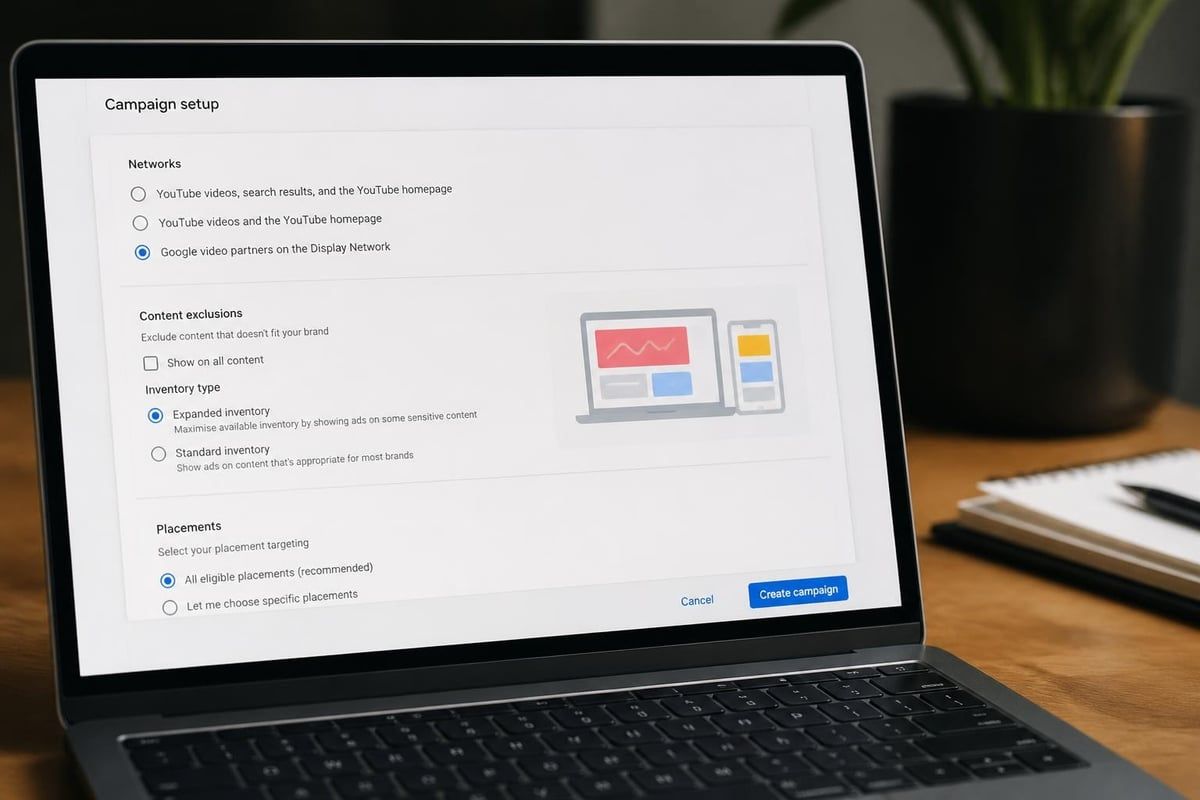
These controls prove essential for maintaining brand safety and ensuring your video content appears in appropriate contexts. Regularly reviewing placement reports and adding exclusions based on performance data helps refine targeting over time.
Performance Measurement and Analytics
Measuring google video partner performance requires a nuanced approach that separates partner metrics from YouTube results. Google Ads provides detailed reporting dimensions that enable performance comparison across network segments.
Key Performance Indicators
Different campaign objectives demand different performance metrics. Understanding which KPIs matter most for your specific goals ensures accurate performance assessment and optimization decisions.
| Campaign Objective | Primary KPIs | Secondary KPIs |
|---|---|---|
| Brand Awareness | Impressions, Reach, View Rate | CPM, Brand Lift |
| Consideration | Views, Engagement Rate, View-Through Rate | Clicks, Website Visits |
| Conversions | Conversions, CPA, ROAS | View-Through Conversions |
| Product Launch | Unique Reach, Frequency, Recall | Search Lift, Interest Growth |
For campaigns promoting social media video content, tracking engagement metrics provides insights into creative resonance across different placement types.
Comparative Analysis Best Practices
Separating YouTube and google video partner performance in reporting reveals which network delivers better results for your specific campaigns. This analysis guides budget optimization and informs future media planning decisions.
Analysis workflow:
- Create custom reports segmenting performance by network
- Compare CPM, view rates, and engagement metrics across segments
- Evaluate conversion performance and attribution paths
- Calculate incremental reach contribution from partner network
- Adjust bid modifiers based on relative performance
Some advertisers discover that google video partners excel for upper-funnel awareness objectives while YouTube drives stronger direct response results. Others find the opposite pattern based on their specific audience and creative approach. Data-driven testing reveals the truth for your unique situation.
Creative Considerations for Partner Placements
Video creative that performs well on YouTube may require adjustments for optimal performance across the google video partner network. Understanding contextual differences between platforms informs creative strategy and production planning.
Optimizing Video Format and Length
Partner placements often feature different viewer contexts and consumption patterns compared to YouTube. Videos appear within editorial content, apps, and streaming environments where viewing behavior differs from intentional YouTube sessions.
Format optimization guidelines:
- Shorter videos (15-30 seconds) often perform better on partner sites
- Front-load key messages within the first 5 seconds to capture attention
- Mobile-first design ensures quality across device types and screen sizes
- Clear branding establishes identity quickly without relying on channel context
- Strong audio design with clear messaging, as viewing environments vary
Professional video production companies understand these nuances and create content specifically optimized for cross-platform performance, ensuring your investment delivers results regardless of placement.
Brand Safety and Context Alignment
While Google implements extensive brand safety measures, advertisers should actively monitor where their content appears and verify alignment with brand values. The diversity of the google video partner network means your ads might appear alongside content quite different from YouTube's environment.
Regular placement audits help identify any sites or apps that don't align with your brand positioning. Most advertisers find the vast majority of placements acceptable, but proactive monitoring prevents potential issues before they impact brand perception.
Advanced Strategies for 2026
As the digital video landscape evolves, sophisticated advertisers employ advanced tactics to maximize google video partner performance and stay ahead of competition.
Layered Audience and Contextual Targeting
Combining audience targeting with contextual signals creates powerful precision that connects your message with the right viewers at optimal moments. This layered approach proves particularly effective across the diverse google video partner network.
Consider a Toronto-based business promoting commercial video production services. A layered strategy might combine:
- Geographic targeting for Greater Toronto Area businesses
- In-market audiences for business services and marketing solutions
- Contextual targeting for business, marketing, and technology content
- Custom intent audiences built from competitor and industry keywords
This multi-dimensional approach ensures ads reach business decision-makers actively researching video production solutions while consuming relevant content across partner sites.

Sequential Messaging and Cross-Network Storytelling
The combination of YouTube and google video partners enables sophisticated sequential messaging strategies that tell evolving brand stories across multiple touchpoints. Viewers might encounter an initial awareness message on YouTube, then see complementary messages across partner placements that deepen engagement.
Sequential messaging framework:
- Awareness stage introduces brand and core value proposition (YouTube focus)
- Consideration stage provides deeper product or service information (cross-network)
- Decision stage delivers specific calls-to-action and offers (retargeting focus)
- Loyalty stage nurtures existing customers with updated content (custom audiences)
This approach requires producing multiple video assets designed to work together as a cohesive campaign narrative. Research on engagement dynamics in online video demonstrates how viewer engagement patterns influence content strategy across different platforms.
Privacy and Measurement Evolution
The digital advertising ecosystem continues adapting to privacy regulations and the deprecation of third-party cookies. These changes impact how advertisers measure and optimize google video partner campaigns in 2026.
First-Party Data Integration
Successful video advertisers increasingly rely on first-party customer data to inform targeting and measurement strategies. Customer Match allows uploading email lists to reach known contacts across the google video partner network while respecting privacy requirements.
First-party data applications:
- Uploading customer lists for direct audience targeting
- Creating lookalike audiences based on customer characteristics
- Excluding existing customers from acquisition campaigns
- Personalizing messaging based on customer lifecycle stage
- Measuring conversion lift among exposed versus unexposed customers
Combining professional video content with robust first-party data creates powerful competitive advantages as third-party targeting capabilities diminish industry-wide.
Consent Mode and Privacy-Preserving Measurement
Google's Consent Mode framework allows advertisers to continue measuring campaign performance while respecting user privacy choices regarding cookie consent. This technology uses conversion modeling to estimate performance metrics when individual-level tracking isn't available.
Understanding these measurement approaches ensures accurate performance assessment and optimization decision-making despite evolving privacy standards. Advertisers should implement Consent Mode across their properties and familiarize themselves with modeled conversion reporting to maintain measurement confidence.
Budget Allocation and Bidding Strategies
Optimizing budget distribution between YouTube and google video partners requires strategic thinking about objectives, performance data, and bidding approaches.
Smart Bidding for Video Campaigns
Google's automated bidding strategies leverage machine learning to optimize toward specified goals across the video network. These algorithms consider countless signals to adjust bids in real-time, maximizing performance within budget constraints.
| Bidding Strategy | Best For | How It Works |
|---|---|---|
| Maximize Conversions | Direct response goals | Spends budget to generate maximum conversions |
| Target CPA | Conversion efficiency | Maintains specific cost-per-acquisition target |
| Maximize Conversion Value | Revenue-focused campaigns | Optimizes for total conversion value |
| Target ROAS | Return-focused campaigns | Achieves specified return on ad spend |
| CPV (Cost-Per-View) | Awareness and reach | Manual bidding for video views |
For businesses investing in video production, smart bidding ensures every dollar spent on media amplification works efficiently toward business objectives, maximizing the return on both production and media investment.
Network-Specific Bid Adjustments
Advanced advertisers apply bid modifiers to increase or decrease bids specifically for google video partner placements based on relative performance. If partner inventory delivers lower conversion rates but acceptable CPMs, a negative bid adjustment maintains presence while optimizing efficiency.
Testing different bid adjustment levels reveals optimal settings for your specific campaigns. Start with small adjustments (plus or minus 10-20%) and monitor impact over several weeks before making larger changes.
Integration with Broader Marketing Strategy
The google video partner network functions most effectively as part of an integrated marketing approach that coordinates video content across paid, owned, and earned channels.
Cross-Channel Video Distribution
Professional video content represents significant investment in production resources. Maximizing ROI requires distributing that content across multiple channels beyond just paid advertising placements.
Multi-channel distribution framework:
- Paid distribution through Google Video Partners and YouTube ads
- Owned channels including website, email, and social profiles
- Earned media via PR placements, partnerships, and organic shares
- Sales enablement through CRM systems and sales team resources
This comprehensive approach ensures your professional video content works across the entire customer journey, from initial awareness through post-purchase loyalty building.
Content Marketing Synergy
Video content created for advertising campaigns can serve double duty as organic content marketing assets. A commercial produced for google video partner distribution might also function as website homepage content, email campaign creative, or social media posts.
Planning video production with this multi-purpose usage in mind maximizes content value and improves overall marketing efficiency. Working with experienced production partners who understand cross-channel requirements ensures deliverables meet technical specifications for various distribution environments.
Competitive Advantages for Service Businesses
For service-based businesses, particularly those in the Greater Toronto Area market, the google video partner network offers unique advantages that complement local marketing strategies.
Local Market Penetration
While the partner network reaches global audiences, precise geographic targeting enables hyper-local campaigns that efficiently reach potential customers within specific markets. This capability proves valuable for service businesses with defined geographic service areas.
Combining location targeting with relevant audience signals creates powerful precision for businesses offering corporate video production services or other professional services. Reaching decision-makers within your service area while they consume business-related content maximizes relevance and conversion potential.
Thought Leadership Positioning
Strategic placement of educational and thought leadership video content across relevant google video partners establishes credibility and expertise. Rather than purely promotional messaging, content that provides genuine value builds trust and positions your business as an industry authority.
This approach works particularly well for professional services where trust and expertise significantly influence purchase decisions. Video content explaining industry trends, best practices, or innovative approaches demonstrates knowledge while subtly showcasing capabilities.
Technical Requirements and Specifications
Successfully leveraging the google video partner network requires understanding technical specifications and requirements for video creative and campaign setup.
Video Ad Format Requirements
Different ad formats serve different campaign objectives and appear in various placements across the partner network. Understanding format options ensures your video content meets technical requirements while achieving campaign goals.
Primary video ad formats:
- In-stream skippable ads that play before, during, or after video content (skippable after 5 seconds)
- In-stream non-skippable ads that must be watched completely (15-20 seconds maximum)
- Bumper ads delivering brief messages in 6 seconds or less
- Out-stream ads appearing on partner sites outside of video players
- In-feed video ads promoting content within discovery feeds and search results
Each format demands specific creative approaches and production considerations. Professional production ensures deliverables meet all technical specifications while maximizing creative impact within format constraints.
Quality and Resolution Standards
Video quality directly impacts viewer engagement and brand perception across google video partner placements. Meeting or exceeding minimum technical standards ensures optimal presentation across diverse devices and platforms.
Recommended specifications:
- Resolution: 1920x1080 minimum (Full HD)
- Aspect ratios: 16:9 (horizontal), 1:1 (square), 9:16 (vertical)
- File format: MP4 or MOV
- Codec: H.264
- Frame rate: 24-30 fps minimum
- Audio: AAC or MP3, 128 kbps minimum
Working with experienced video production professionals ensures technical excellence while maintaining creative quality that drives results.
Future Developments and Industry Trends
The google video partner ecosystem continues evolving as viewing habits shift and new technologies emerge. Understanding likely developments helps advertisers prepare strategies for coming changes.
Connected TV and Streaming Integration
Connected TV (CTV) represents the fastest-growing segment within the google video partner network. As viewers increasingly consume content through streaming platforms and smart TVs, advertising opportunities in these environments expand significantly.
CTV placements offer unique advantages including larger screens, engaged viewing environments, and household-level targeting. Advertisers should test CTV-specific campaigns to understand performance characteristics and optimize creative for this growing channel.
AI-Powered Creative Optimization
Artificial intelligence increasingly influences video advertising effectiveness through automated creative testing, dynamic creative optimization, and predictive performance modeling. These technologies help advertisers identify winning creative elements and optimize campaigns faster than manual approaches.
Understanding research on video content analysis and machine learning applications provides context for how AI technologies evaluate and optimize video performance across platforms.
The google video partner network offers powerful opportunities for businesses seeking to maximize video advertising reach and efficiency in 2026. By extending campaigns beyond YouTube while maintaining Google's targeting precision and brand safety standards, advertisers connect with audiences across thousands of premium placements. Success requires strategic planning, quality creative, ongoing optimization, and integration with broader marketing initiatives. Whether you're launching your first video campaign or refining advanced strategies, partnering with experienced professionals ensures maximum return on your video investment. Viva Media combines production excellence with strategic marketing expertise, creating video content engineered for performance across Google Video Partners and beyond, delivering measurable results for Toronto-area businesses ready to amplify their message.