


The advertising landscape has undergone a fundamental transformation over the past decade, with digital video advertising emerging as the dominant force reshaping how brands connect with audiences. This shift isn't merely a trend but a strategic imperative driven by changing consumer behavior, technological advancement, and the proven effectiveness of video content in capturing attention and driving conversions. As businesses allocate their marketing budgets for 2026, understanding the mechanics, platforms, and best practices of digital video advertising has become essential for staying competitive in an increasingly crowded marketplace.
The Evolution and Market Growth of Digital Video Advertising
The meteoric rise of digital video advertising represents one of the most significant shifts in marketing history. According to recent projections, the global digital video advertising market is expected to reach $712.6 billion by 2031, growing at a compound annual growth rate of 29.6%. This explosive growth reflects the undeniable effectiveness of video content in driving engagement and conversions across virtually every industry vertical.
The decline of traditional advertising channels has accelerated this transition. Local TV has lost more than half of its share of media spending since 2017, with advertisers redirecting those budgets toward digital platforms that offer superior targeting, measurement, and return on investment. This reallocation of resources demonstrates that digital video advertising isn't competing with traditional media-it's replacing it.

Understanding the Platform Ecosystem
Digital video advertising encompasses multiple platforms, each offering unique advantages for reaching specific audience segments:
Social Media Platforms
- Instagram and Facebook video ads with advanced targeting capabilities
- TikTok's full-screen vertical format designed for mobile-first audiences
- LinkedIn video content for B2B engagement and professional audiences
- YouTube's massive reach and intent-based advertising opportunities
Connected TV (CTV) and Over-the-Top (OTT)
- Streaming platforms delivering television-quality content with digital targeting
- Addressable TV advertising that combines broadcast reach with precision targeting
- Interactive video experiences that bridge the gap between awareness and conversion
Programmatic Video Advertising
- Automated buying and placement across multiple platforms simultaneously
- Real-time bidding for optimal cost efficiency
- Data-driven targeting using first-party and third-party audience insights
The broader entertainment and media industry is projected to reach $3.5 trillion by 2029, with advertising serving as the primary growth driver. This expansion creates unprecedented opportunities for brands willing to invest in high-quality video content that resonates with their target audiences.
Creating High-Performance Video Advertising Content
The effectiveness of digital video advertising depends fundamentally on content quality and strategic alignment with business objectives. Unlike traditional advertising that relied on frequency and broad reach, digital video demands precision, relevance, and measurable impact from the first frame.
Production Quality Standards
Professional video production has become non-negotiable in the digital advertising space. Audiences have developed sophisticated expectations shaped by streaming services, social media influencers, and premium brand content. Working with experienced video production companies ensures your advertising content meets these elevated standards while maintaining authentic brand voice.
| Production Element | Impact on Performance | Quality Benchmark |
|---|---|---|
| Visual Resolution | Professionalism perception | 1080p minimum, 4K preferred |
| Audio Quality | Message retention | Studio-grade recording |
| Color Grading | Brand consistency | Professional color correction |
| Motion Graphics | Information clarity | Smooth, purposeful animation |
Understanding video pricing helps businesses make informed decisions about production investment levels aligned with campaign objectives and expected returns.
Strategic Content Development
Effective digital video advertising content follows specific principles that maximize engagement and conversion potential:
Opening Sequences Matter The first three seconds determine whether viewers continue watching or scroll past. Successful videos immediately establish relevance through visual hooks, provocative questions, or compelling value propositions.
Mobile Optimization is Mandatory With mobile devices accounting for the majority of video consumption, following best practices for mobile-friendly ads ensures content performs across all viewing contexts. Vertical and square formats often outperform traditional horizontal orientations on social platforms.
Sound-Off Viewing Requires Adaptation Most social media videos play initially without sound, making captions, text overlays, and visual storytelling essential for message delivery. The IAB's digital video creative best practices recommend designing content that communicates effectively both with and without audio.

Platform-Specific Optimization Strategies
Each digital video advertising platform requires tailored approaches to maximize performance. Generic content distributed identically across all channels rarely achieves optimal results compared to platform-native strategies.
Social Media Video Specifications
Different platforms demand specific technical requirements and creative approaches:
Instagram and Facebook
- Feed videos: 1:1 square format, 30-60 seconds optimal length
- Stories and Reels: 9:16 vertical format, 15-30 seconds recommended
- IGTV: Longer-form content up to 60 minutes for engaged audiences
- Carousel ads: Multiple videos in sequence for storytelling depth
TikTok
- Full-screen 9:16 vertical format mandatory
- Native, authentic aesthetic outperforms polished commercial content
- Trending sounds and challenges drive organic amplification
- 21-34 second duration shows highest completion rates
- Professional tone with educational or thought leadership positioning
- 1:1 square format for feed, 16:9 horizontal for native video
- Captions essential as most viewers watch without sound
- 30-90 seconds optimal for maintaining professional audience attention
Connected TV Advertising Considerations
Connected TV represents the fastest-growing segment of digital video advertising, combining television's premium viewing environment with digital targeting precision. However, security concerns around counterfeit devices highlight the importance of working with reputable platforms and monitoring campaign performance closely.
CTV advertising requires different creative approaches than social media:
- Longer format opportunities (15-30 seconds standard, up to 60 seconds viable)
- Television production quality expectations from audiences
- Less frequent skipping compared to pre-roll ads on other platforms
- Household-level targeting rather than individual user targeting
Measuring Digital Video Advertising Performance
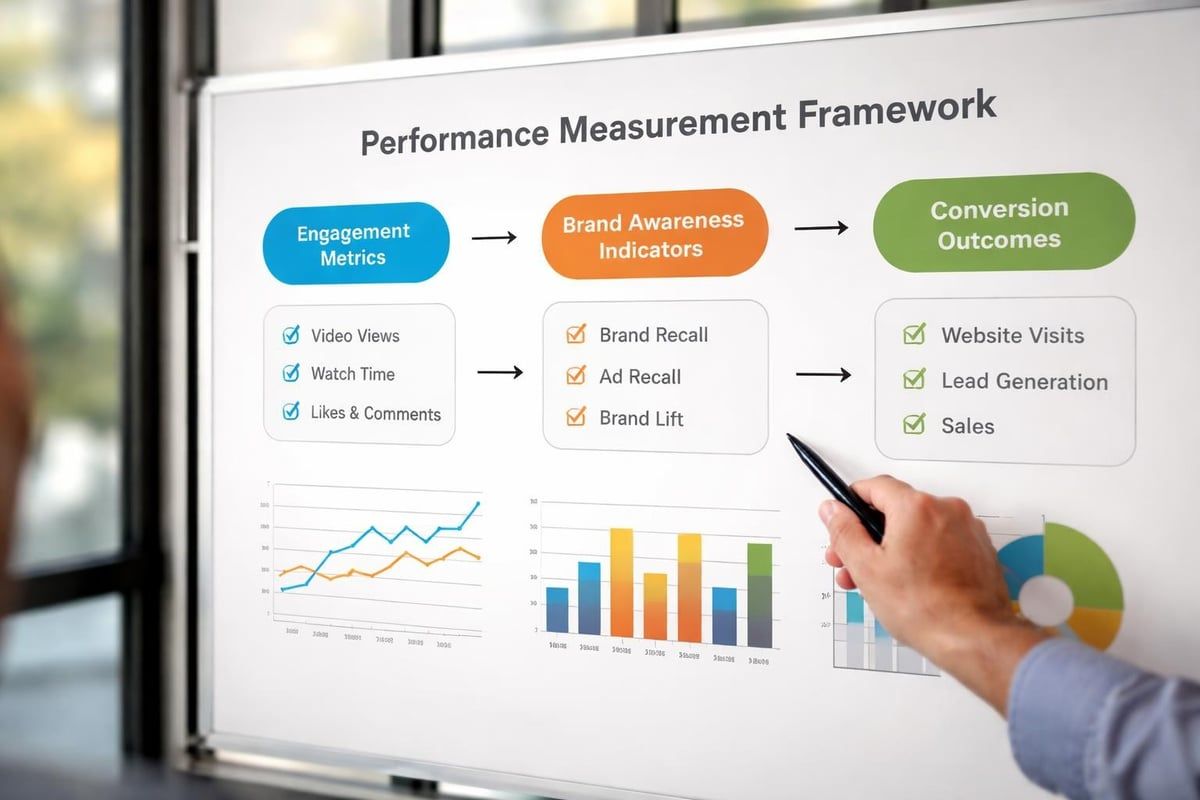
The accountability inherent in digital video advertising represents one of its most significant advantages over traditional media. Comprehensive measurement capabilities enable continuous optimization and clear demonstration of return on investment.
Key Performance Metrics
| Metric Category | Specific Indicators | Strategic Significance |
|---|---|---|
| Engagement | View-through rate, completion rate, clicks | Content resonance and relevance |
| Brand Impact | Brand lift, ad recall, message association | Upper-funnel awareness building |
| Conversion | Click-through rate, conversion rate, cost per acquisition | Direct business outcomes |
| Efficiency | Cost per view, cost per completed view, return on ad spend | Budget optimization and scaling decisions |
View-Through Rate (VTR) The percentage of viewers who watch your complete video provides crucial insight into content effectiveness. Industry benchmarks vary by platform, but VTRs above 40% typically indicate strong content-audience alignment.
Completion Rate Measuring how many viewers watch to the final frame reveals whether your content maintains engagement throughout its duration. Drop-off points indicate where messaging loses relevance or fails to maintain interest.
Brand Lift Studies Controlled experiments comparing exposed and unexposed audiences measure changes in brand awareness, consideration, and purchase intent attributable to your video advertising campaigns.
Attribution and Conversion Tracking
Digital video advertising enables sophisticated attribution modeling that connects video exposure to downstream business outcomes. View-through conversions capture users who see your video advertisement but don't immediately click, later returning through other channels to convert.
Multi-touch attribution models recognize that digital video advertising often plays an assistive role in customer journeys rather than serving as the final touchpoint before conversion. This recognition ensures appropriate credit allocation and accurate ROI calculation.
Advanced Targeting and Personalization Techniques
The targeting capabilities available in digital video advertising far exceed anything possible in traditional media, enabling precision audience reach that maximizes efficiency and relevance.
Audience Segmentation Approaches
Demographic Targeting Basic demographic filters including age, gender, location, income, and education level provide foundational audience definition. While useful, demographic targeting alone rarely achieves optimal performance compared to behavioral and psychographic approaches.
Behavioral Targeting User actions, purchase history, content consumption patterns, and website interactions enable sophisticated behavioral segmentation. Corporate video production for specific industries benefits tremendously from behavioral targeting that reaches decision-makers based on their professional activities.
Interest and Affinity Targeting Platform algorithms identify users with demonstrated interest in specific topics, hobbies, or product categories. This targeting approach reaches potential customers during relevant content consumption rather than interrupting unrelated activities.
Custom Audiences and Lookalikes Uploading existing customer lists enables retargeting campaigns that nurture relationships with known contacts. Lookalike audiences extend reach to new users who share characteristics with your best existing customers.
Dynamic Creative Optimization
Advanced digital video advertising platforms support dynamic creative optimization (DCO) that automatically tests multiple creative variations, identifying which combinations of headlines, calls-to-action, visuals, and formats perform best with different audience segments.
This technology-driven approach surpasses traditional A/B testing by:
- Testing dozens of creative variations simultaneously
- Automatically allocating budget toward top performers
- Adapting creative elements based on viewer characteristics
- Continuously learning and improving throughout campaign lifecycles
Budget Allocation and Bidding Strategies
Effective digital video advertising requires strategic budget management across platforms, formats, and campaign objectives. Understanding the cost dynamics and bidding mechanisms of different platforms enables efficient resource allocation.
Platform Cost Considerations
Cost per Thousand Impressions (CPM) Display-focused campaigns optimizing for reach and awareness typically operate on CPM pricing models. Average CPMs vary significantly by platform, targeting specificity, and competitive intensity within your industry.
Cost per View (CPV) Video-specific pricing where advertisers pay only when viewers watch a defined portion of the video (often 30 seconds or completion for shorter videos). This model aligns costs with actual engagement rather than mere exposure.
Cost per Click (CPC) Performance-oriented campaigns focused on website traffic or conversions often use CPC bidding, paying only when viewers actively engage by clicking through to landing pages.
Bidding Strategy Selection
| Bidding Strategy | Best Use Case | Risk Profile |
|---|---|---|
| Manual Bidding | Small campaigns requiring tight control | Low risk, limited scale |
| Target CPM | Awareness campaigns prioritizing reach | Medium risk, predictable costs |
| Target CPA | Conversion-focused campaigns with historical data | Higher risk, maximum efficiency |
| Maximize Conversions | Established campaigns with conversion tracking | Medium risk, algorithm-dependent |
Starting with conservative manual bidding while gathering performance data provides the foundation for transitioning to automated strategies that leverage machine learning for optimization.
Best Practices for Campaign Management
Sustained success with digital video advertising requires disciplined campaign management practices that balance creative excellence with analytical rigor.
Testing and Iteration Frameworks
Creative Testing Protocol Successful advertisers continuously test creative variations rather than relying on single video assets. Testing different opening hooks, calls-to-action, video lengths, and messaging angles reveals which approaches resonate most strongly with target audiences.
Structured testing follows these principles:
- Change only one variable per test to isolate performance drivers
- Run tests long enough to achieve statistical significance
- Document learnings systematically for application across future campaigns
- Scale winning variations while retiring underperformers
Frequency Management Excessive frequency causes ad fatigue, diminishing returns, and negative brand sentiment. Monitoring frequency metrics and implementing frequency caps prevents overexposure while maintaining sufficient repetition for message retention.
Landing Page Optimization
Digital video advertising performance depends heavily on post-click experiences. Following digital advertising best practices ensures landing pages deliver on the promises made in video content while minimizing friction in the conversion process.
Effective landing pages feature:
- Message consistency between video ad and page content
- Mobile-responsive design accommodating all device types
- Clear, prominent calls-to-action above the fold
- Fast loading speeds preventing abandonment
- Minimal form fields reducing conversion barriers
Emerging Trends Shaping Future Opportunities
Digital video advertising continues evolving rapidly, with several emerging trends creating new opportunities for forward-thinking advertisers.
Artificial Intelligence and Automation
Advanced AI systems are transforming digital video advertising through improved targeting, creative optimization, and performance prediction. Contextual advertising technologies now analyze video content to deliver relevant advertisements within appropriate viewing contexts, moving beyond simple demographic targeting.
Machine learning algorithms predict which audiences are most likely to engage with specific video content, enabling preemptive optimization before campaigns fully launch. These systems continuously learn from performance data, improving efficiency throughout campaign lifecycles.
Interactive Video Experiences
Moving beyond passive viewing, interactive video formats enable viewers to engage directly with content through:
- Clickable hotspots revealing additional product information
- Branching narratives where viewers choose story directions
- Shoppable videos enabling direct purchases within the viewing experience
- Polls and surveys gathering audience feedback while maintaining engagement
Interactive elements increase engagement duration, improve message retention, and create measurable action opportunities beyond traditional view-through metrics.
Short-Form Video Dominance
The explosive growth of TikTok, Instagram Reels, and YouTube Shorts reflects fundamental shifts in content consumption patterns. Audiences increasingly prefer short-form video content that delivers immediate value without significant time investment.
This trend demands new creative approaches:
- Front-loading key messages in opening seconds
- Embracing authentic, less polished aesthetics
- Adapting storytelling techniques for compressed timeframes
- Designing content for serial consumption rather than standalone viewing
Exploring effective video advertising strategies reveals how brands successfully adapt to these format preferences while maintaining message impact.
Building Integrated Video Marketing Ecosystems
Digital video advertising achieves maximum impact when integrated into comprehensive marketing ecosystems rather than executed as isolated campaigns. Strategic integration amplifies performance across all marketing channels.
Cross-Platform Content Strategies
Creating video content specifically for paid advertising while simultaneously developing organic social media content, website video, and email video components ensures consistent messaging across all customer touchpoints. This integrated approach reinforces brand positioning while maximizing content production investment.
Professional video production services often create multiple deliverables from single production shoots, adapting core content for different platforms, formats, and campaign objectives.
Retargeting and Sequential Messaging
Sequential video advertising campaigns deliver different messages based on previous engagement levels, creating cohesive narratives that guide prospects through awareness, consideration, and conversion stages.
Typical sequences include:
- Awareness video introducing brand value proposition to cold audiences
- Consideration video providing detailed information to engaged viewers
- Conversion video addressing objections and providing strong calls-to-action
- Retention video nurturing existing customers toward repeat purchases
This strategic sequencing mirrors natural customer journey progression while maintaining advertising efficiency through precise audience targeting.
Performance Attribution Across Channels
Understanding how digital video advertising influences performance across all marketing channels requires sophisticated attribution modeling. Video exposure often generates downstream effects including:
- Increased branded search volume
- Higher email open and click-through rates
- Improved organic social media engagement
- Elevated direct website traffic
Comprehensive measurement frameworks capture these cross-channel impacts, providing accurate assessment of digital video advertising's total contribution to business outcomes.
Digital video advertising has fundamentally transformed how businesses connect with audiences, offering unprecedented targeting precision, measurable results, and creative flexibility that traditional advertising simply cannot match. By combining strategic platform selection, high-quality content production, data-driven optimization, and integrated campaign management, businesses can leverage video advertising to drive meaningful growth in 2026 and beyond. Viva Media specializes in creating high-performance video content engineered specifically for digital advertising success, partnering with Toronto-area brands to develop campaigns that deliver measurable business results across all major platforms.