
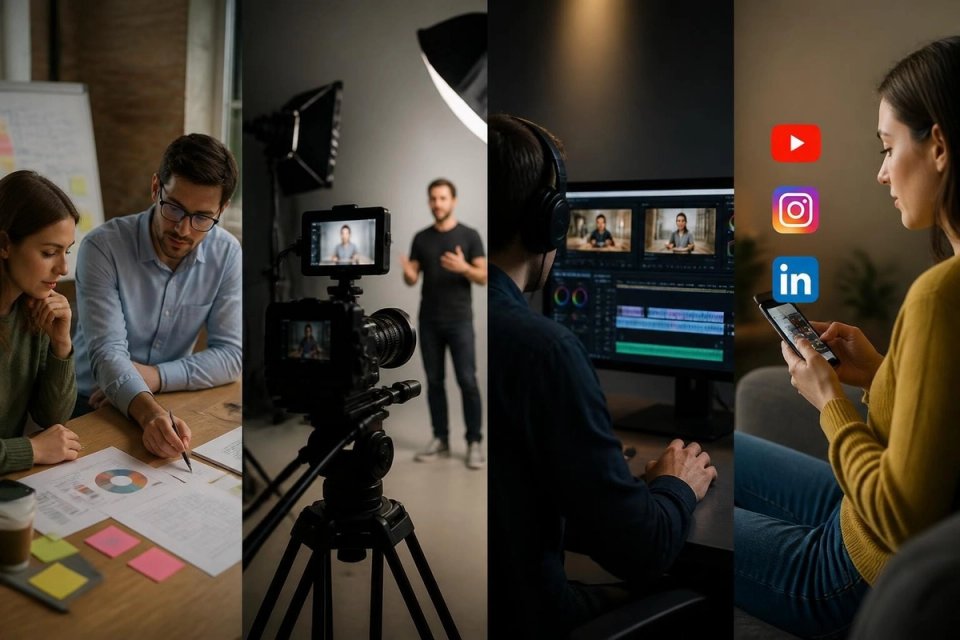
Marketing videos have become the cornerstone of effective digital communication in 2026. Businesses that create a marketing video strategically see higher engagement rates, improved conversion metrics, and stronger brand recognition compared to text-only content. The ability to convey complex messages through visual storytelling gives companies a competitive edge in crowded markets. Whether you're promoting a product launch, explaining a service, or building brand awareness, understanding the complete production process ensures your investment delivers measurable returns.
Understanding Your Marketing Video Objectives
Before you pick up a camera or write a single line of script, you need to define what success looks like for your project. Marketing videos serve different purposes, and clarity around your primary objective shapes every subsequent decision.
Common marketing video objectives include:
- Increasing brand awareness among target audiences
- Driving product sales or service bookings
- Educating customers about complex solutions
- Building trust through testimonial content
- Generating qualified leads for sales teams
When you create a marketing video without clear objectives, you risk producing content that looks professional but fails to move business metrics. HubSpot's comprehensive guide on marketing videos emphasizes that goal-setting determines everything from video length to distribution channels.
Defining Key Performance Indicators
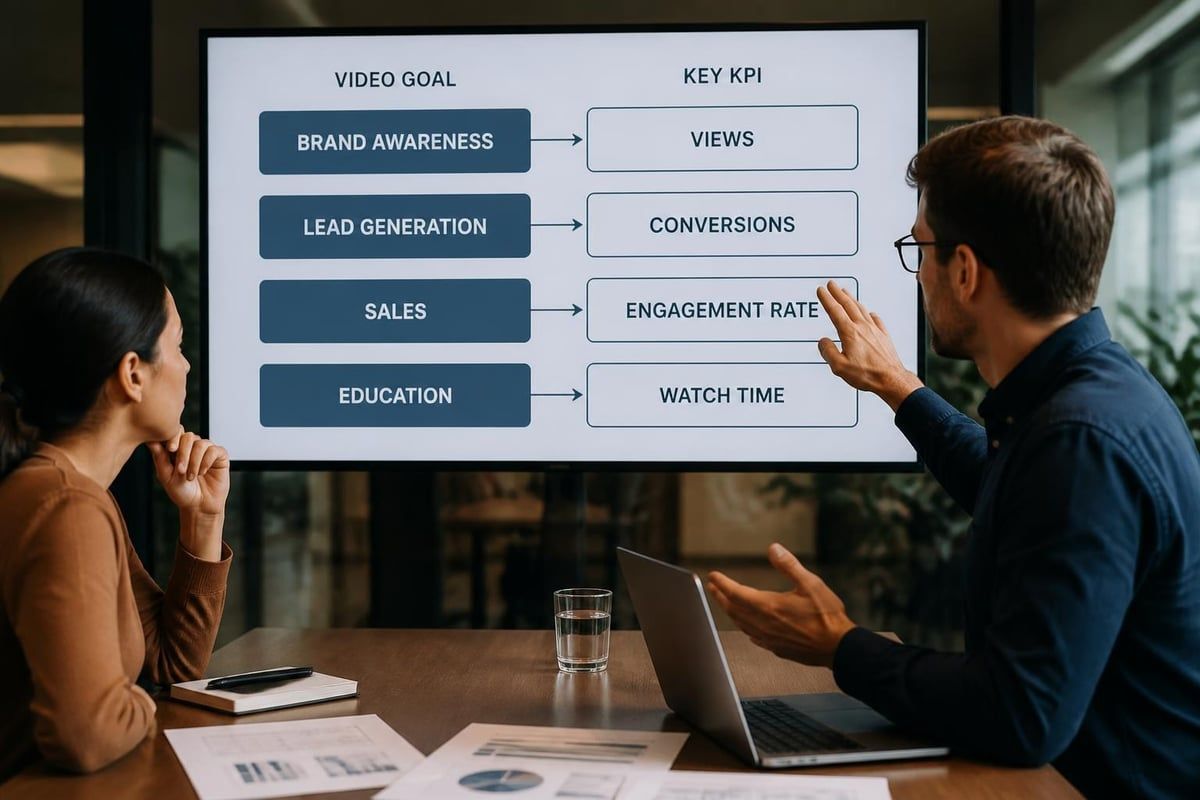
Your objectives need corresponding measurements. A brand awareness video might track view count and reach, while a lead generation piece focuses on click-through rates and form submissions. Establishing these KPIs before production begins allows you to design calls-to-action and tracking mechanisms into your video from the start.
| Objective | Primary KPI | Secondary KPI |
|---|---|---|
| Brand Awareness | Total Views | Social Shares |
| Lead Generation | Form Submissions | Click-Through Rate |
| Product Sales | Conversion Rate | Add-to-Cart Actions |
| Customer Education | Watch Time | Completion Rate |
Developing Your Core Message and Script
Once objectives are clear, you need to distill your message into a compelling narrative. The most effective marketing videos communicate one central idea rather than cramming multiple messages into a single piece. This focused approach respects viewer attention spans while creating memorable content.
Your script serves as the blueprint for everything that follows. Start by identifying the problem your audience faces, present your solution, and conclude with a clear next step. This problem-solution-action framework works across industries and video types.
Scripting Best Practices
Professional scriptwriting balances information density with engagement. Write for the ear, not the eye. Sentences that read well on paper often sound stilted when spoken. Read your script aloud multiple times, refining until it flows naturally.
Keep language conversational and specific. Instead of "our solution helps businesses," say "our platform reduces customer service response time by 47%." Concrete details create credibility and make abstract concepts tangible.
When working with corporate video production services, experienced teams collaborate on script development, bringing insights about what resonates with B2B audiences versus consumer markets. Lumen5's B2B video guide outlines how professional scriptwriting differs across audience types.
Planning Your Production Approach
The decision to create a marketing video in-house versus partnering with professionals depends on several factors including budget, timeline, technical complexity, and desired quality level. Each approach offers distinct advantages.
In-house production advantages:
- Lower direct costs for simple projects
- Complete creative control
- Faster iteration on minor changes
- Building internal capabilities
Professional production advantages:
- Broadcast-quality results
- Experienced creative direction
- Access to specialized equipment
- Efficient project management
Most businesses find that working with a video production company accelerates results while ensuring technical excellence. Professional teams understand lighting, sound design, color grading, and dozens of other variables that separate amateur content from polished marketing assets.
Creating Your Production Timeline
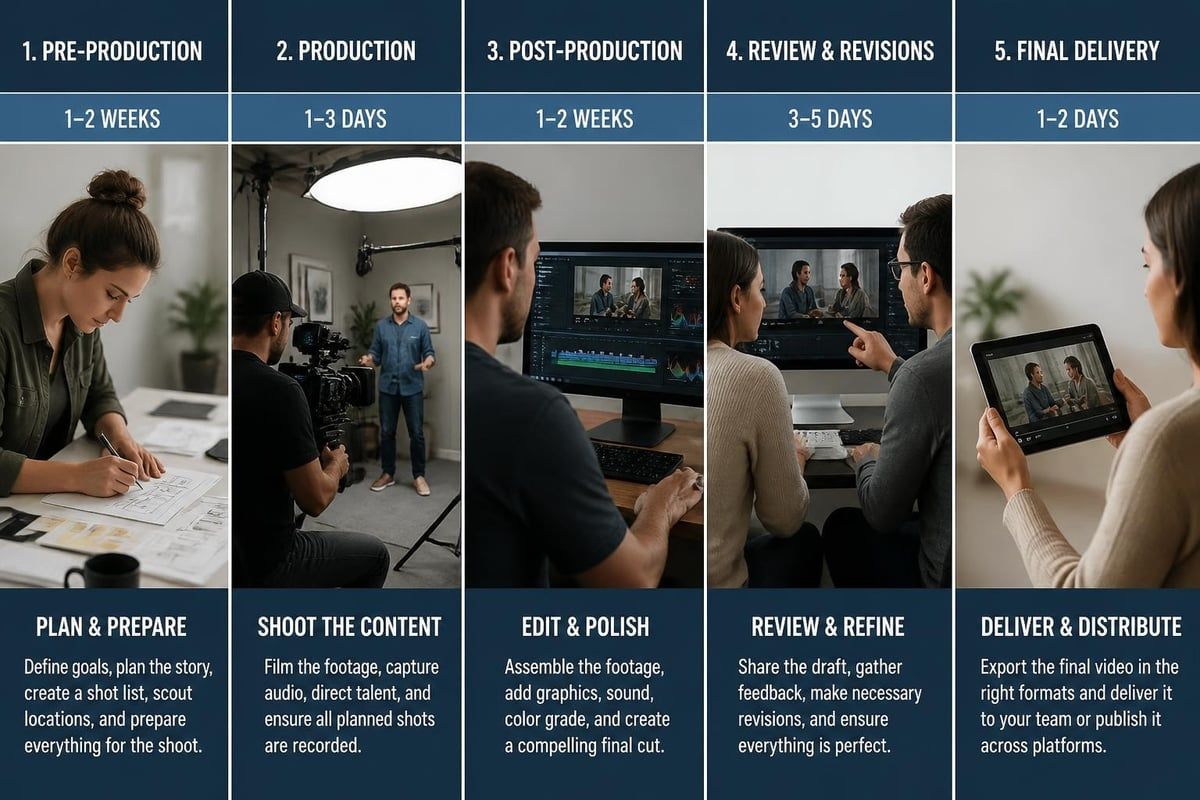
A typical marketing video production follows this timeline structure:
- Pre-production (1-2 weeks): Script finalization, location scouting, talent selection, equipment preparation
- Production (1-3 days): Principal photography, interview filming, b-roll capture
- Post-production (1-3 weeks): Editing, color correction, sound mixing, graphics integration
- Revisions (3-5 days): Client feedback implementation, final adjustments
- Delivery and distribution (1 week): Format optimization, platform uploads, launch coordination
Rush projects compress these phases but may sacrifice quality or increase costs. When you create a marketing video on an accelerated schedule, clear communication and decisive feedback become even more critical.
Mastering Technical Production Elements
Quality production requires attention to multiple technical components working in harmony. While professional crews handle these details seamlessly, understanding the fundamentals helps you evaluate vendor capabilities or improve in-house efforts.
Lighting Fundamentals
Proper lighting transforms amateur footage into professional content. Three-point lighting remains the industry standard, using a key light for primary illumination, fill light to soften shadows, and back light to separate subjects from backgrounds. Natural light can work beautifully but requires scheduling around optimal times and weather conditions.
Audio Quality Matters
Poor audio ruins otherwise excellent video. Invest in quality microphones suited to your shooting environment. Lavalier mics work well for interviews, shotgun mics capture directional sound, and USB mics suit voiceover recording. Always monitor audio levels during recording and capture room tone for editing flexibility.
Camera Work and Composition
Shot variety maintains viewer interest. Mix wide establishing shots with medium frames and tight close-ups. Follow the rule of thirds for pleasing composition. Camera movement should serve the story, not distract from it. Stable footage matters, whether achieved through tripods, gimbals, or steadicam systems.
| Technical Element | Amateur Approach | Professional Standard |
|---|---|---|
| Lighting | Available light only | Controlled three-point setup |
| Audio | Built-in camera mic | Dedicated microphones + recorder |
| Camera Work | Single static angle | Multiple cameras, varied shots |
| Color | Camera default settings | Color grading in post-production |
Editing Your Marketing Video for Maximum Impact
The editing phase transforms raw footage into a cohesive narrative. Modern editing software offers powerful capabilities, but technical proficiency matters less than storytelling instinct. Every cut, transition, and effect should advance your message.
Start with a rough assembly that sequences clips in script order. This gives you a foundation for refinement. Trim aggressively. Your first cut will almost certainly run too long. Remove anything that doesn't directly support your core message.
Pacing and Rhythm
Attention spans remain limited in 2026. Marketing videos typically perform best under two minutes for social platforms, though educational content and product demonstrations can justify longer formats when providing genuine value.
Vary shot lengths to create visual rhythm. Quick cuts energize action sequences while longer holds allow emotional moments to resonate. Match pacing to your brand personality. A luxury brand might embrace slower, more contemplative editing while a youth-focused product demands kinetic energy.
Graphics and Motion Elements
Lower thirds identify speakers and reinforce key information. Animated text highlights important statistics or calls-to-action. Transitions guide viewers between sections smoothly. These elements should complement your content, not overwhelm it.
Brand consistency matters across all graphic elements. Use approved logos, fonts, and color schemes. When you create a marketing video as part of a larger campaign, visual coherence across all assets strengthens brand recognition.
Optimizing for Different Distribution Platforms
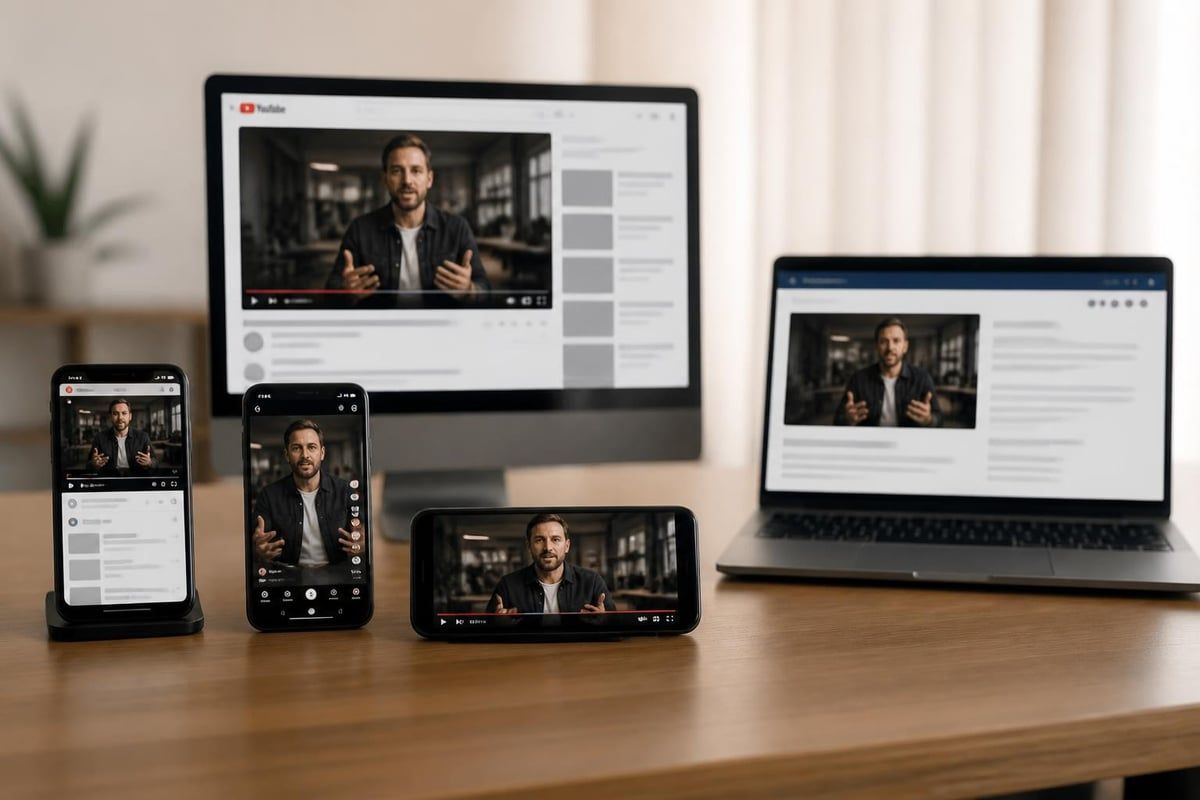
Where your video lives determines how you build it. A YouTube video allows longer storytelling while Instagram Reels demand vertical format and immediate hooks. Social media video production requires platform-specific optimization from the planning stage.
Platform-specific considerations:
- YouTube: Horizontal 16:9, thumbnails critical, first 15 seconds determine retention
- Instagram Feed/Reels: Vertical 9:16 or square 1:1, captions essential for sound-off viewing
- LinkedIn: Professional tone, horizontal format, longer educational content performs well
- TikTok: Vertical format, authentic over polished, trend participation boosts reach
- Website: Multiple formats available, embedding and page speed optimization important
Create primary content for your main platform, then adapt strategically for secondary channels. A single shoot can generate a 90-second YouTube video, three 15-second Instagram cutdowns, and six still images for various marketing uses.
Optimizing Video Files
File size impacts loading speed and user experience. Export settings should balance quality with performance. H.264 codec remains the standard for web distribution, with 1080p resolution suitable for most applications. 4K adds file size without meaningful quality improvement for typical viewing conditions.
Consider creating captions for accessibility and sound-off viewing. Studies show 85% of social video plays without sound. Burned-in captions or platform caption files ensure your message reaches viewers regardless of audio conditions.
Leveraging AI Tools in Video Production
Artificial intelligence has transformed accessibility in video creation. When you create a marketing video in 2026, AI assists at every stage from scriptwriting to editing. TechSifted explores AI-powered video creation showing how these tools democratize professional-quality production.
AI script generators provide starting points that human writers refine. Text-to-speech creates natural-sounding voiceovers in multiple languages. Automated editing tools assemble footage based on script analysis. Background removal eliminates green screens for many applications.
AI capabilities in video production:
- Script generation and refinement
- Automated transcription and captioning
- Voice synthesis for narration
- Video editing based on script
- Background replacement
- Music and sound effect selection
However, AI tools work best as assistants rather than replacements. The strategic thinking, creative direction, and brand understanding that make marketing videos effective still require human expertise. Commercial video production combines AI efficiency with human creativity for optimal results.
Measuring Performance and Iterating
Publishing your video marks the beginning of the optimization cycle, not the end. Comprehensive analytics reveal what works and what needs adjustment for future projects.
Most platforms provide native analytics showing views, watch time, engagement rate, and audience demographics. Google Analytics tracks how video impacts website behavior including time on page, bounce rate, and conversion actions. Marketing automation platforms connect video engagement to lead quality and sales outcomes.
Key Metrics to Monitor
| Metric | What It Reveals | Optimization Opportunity |
|---|---|---|
| Play Rate | Thumbnail/title effectiveness | Test different thumbnails |
| Average Watch Time | Content engagement level | Tighten pacing, stronger hook |
| Click-Through Rate | Call-to-action clarity | Refine CTA placement/wording |
| Conversion Rate | Overall campaign effectiveness | Align video message with landing page |
When specific videos underperform, analyze drop-off points. If 70% of viewers leave at the 30-second mark, that section needs revision. A/B test different approaches. Create variations with different hooks, lengths, or calls-to-action to identify what resonates with your audience.
Building a Sustainable Video Marketing Strategy
One exceptional video creates impact. A consistent video marketing program builds lasting competitive advantage. When you create a marketing video as part of a strategic content calendar, each piece reinforces the others while allowing experimentation and learning.
Successful video strategies balance consistency with adaptability. Establish production rhythms that your team can sustain. Monthly deep-dive content might pair with weekly short-form social videos. Quarterly product launches could include comprehensive video campaigns with multiple supporting assets.
Components of sustainable video marketing:
- Editorial calendar aligning videos with business objectives
- Reusable templates for recurring video types
- Content repurposing strategies maximizing each shoot
- Performance benchmarks guiding continuous improvement
- Budget allocation balancing quality with volume
Advertising video production requires balancing creative ambition with practical constraints. The most effective programs establish clear processes that deliver consistent quality while leaving room for breakthrough creative when opportunities arise.
Developing Internal Capabilities
Even businesses working with professional production partners benefit from building internal video literacy. Understanding production fundamentals helps you provide better creative direction, evaluate vendor proposals, and identify opportunities for video applications across your organization.
Train marketing team members on smartphone video techniques for behind-the-scenes content and quick social updates. Invest in basic equipment for simple internal communications. Reserve professional partnerships for customer-facing content where quality directly impacts brand perception and business results.
Incorporating Storytelling Principles
Technical excellence without compelling storytelling produces forgettable content. The marketing videos that drive results connect emotionally while delivering information. Adwave emphasizes storytelling in marketing videos, noting that narrative structure separates content people watch from content they remember and act upon.
Every effective story includes characters facing challenges and achieving transformation. In marketing videos, your customer is the hero, their problem is the challenge, and your product or service enables their success. This customer-centric framing creates more engaging content than product-focused presentations.
Core storytelling elements:
- Opening hook: Grab attention within three seconds with a compelling question, surprising statement, or striking visual
- Relatable problem: Present challenges your audience recognizes from their own experience
- Clear solution: Demonstrate how your offering addresses the problem specifically
- Proof points: Support claims with data, testimonials, or demonstrations
- Compelling close: End with clear next steps that feel natural rather than pushy
When you create a marketing video using these storytelling principles, viewers connect emotionally with your message. Emotional connection drives the sharing, commenting, and conversion behaviors that generate ROI from video investments.
Creating effective marketing videos requires strategic planning, technical excellence, and compelling storytelling working in concert. The businesses that excel understand video not as a one-time project but as an ongoing discipline requiring continuous learning and optimization. Whether you're producing simple social content or comprehensive campaign videos, applying these principles elevates results and maximizes return on investment. Viva Media partners with forward-thinking Toronto brands to create high-performance video content that captures attention and delivers measurable business outcomes, combining strategic insight with production excellence to help your message break through in crowded markets.