


Creating video content without a clear strategy is like filming in the dark-you might capture something interesting, but you're more likely to waste resources and miss your mark entirely. A well-crafted video content strategy transforms random video production into a systematic approach that generates measurable business outcomes, whether you're launching products, building brand awareness, or nurturing customer relationships. For brands in the Greater Toronto Area and beyond, understanding how to architect a comprehensive strategy has become essential to standing out in an increasingly crowded digital landscape where consumers watch billions of hours of video content daily.
Understanding the Foundation of Video Content Strategy
A video content strategy serves as the blueprint that connects your business objectives with the specific video assets you'll create, how you'll distribute them, and the metrics you'll use to measure success. Unlike one-off video projects, a strategic approach considers the entire customer journey and positions different video types at crucial touchpoints where they'll deliver maximum impact.
The foundation starts with clarity about what you want to achieve. Business objectives might include increasing brand awareness by 40%, generating 500 qualified leads per quarter, reducing customer support inquiries by 25%, or improving conversion rates on specific landing pages. Each objective requires different video formats, messaging approaches, and distribution tactics.
Defining Your Core Objectives
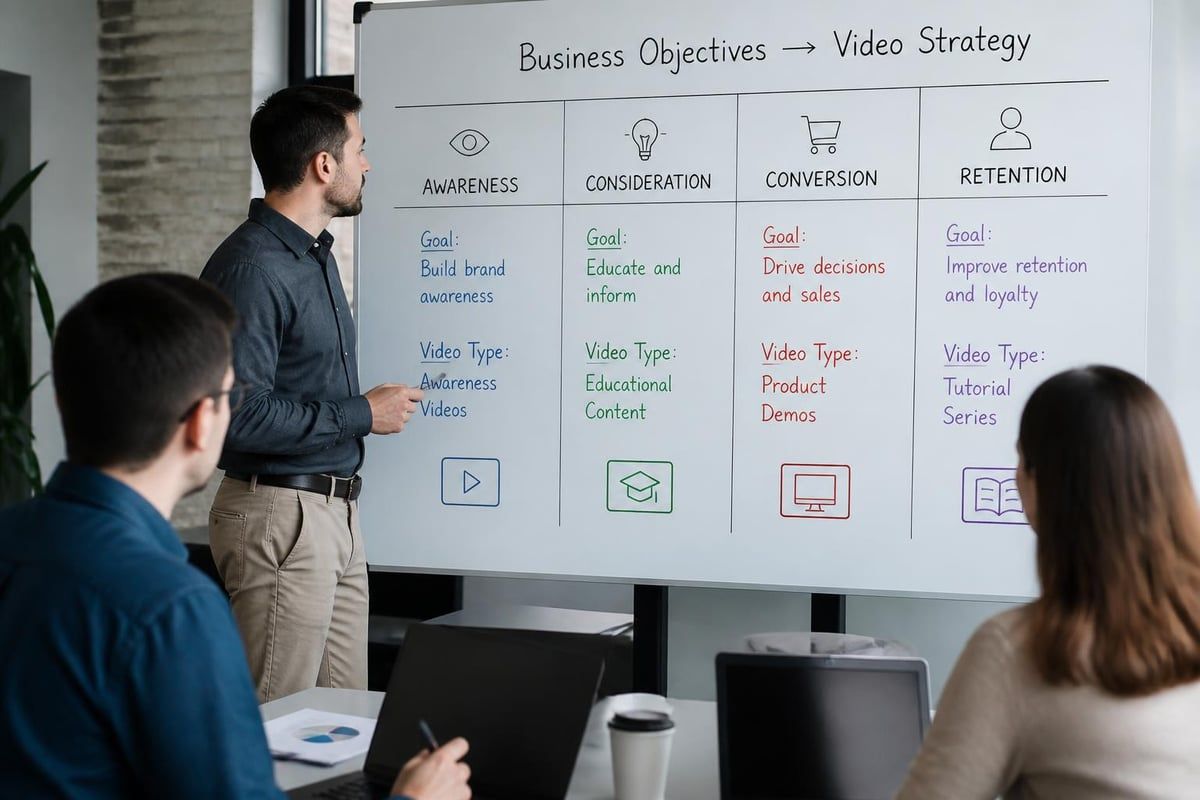
Your video content strategy must align with broader business goals rather than existing in isolation. Consider these primary objective categories:
- Awareness objectives: Building brand recognition, reaching new audiences, establishing thought leadership
- Consideration objectives: Educating prospects, demonstrating product value, addressing objections
- Conversion objectives: Driving purchases, generating leads, encouraging sign-ups
- Retention objectives: Onboarding customers, reducing churn, increasing lifetime value
- Advocacy objectives: Encouraging referrals, building community, generating user content
Research from video content marketing experts emphasizes that clear objectives form the backbone of any successful video initiative, directly influencing creative decisions, budget allocation, and performance measurement frameworks.
Conducting Audience Research and Segmentation
Effective video content speaks directly to the viewer's needs, challenges, and aspirations. This requires deep audience understanding that goes beyond basic demographics to include psychographics, behavioral patterns, and consumption preferences. In 2026, successful brands leverage advanced analytics and customer data platforms to create detailed audience profiles.
Start by identifying your primary audience segments. A B2B technology company might segment audiences into C-suite executives seeking ROI proof, IT managers needing technical specifications, and end users wanting ease-of-use demonstrations. Each segment consumes content differently and responds to distinct messaging approaches.
Building Detailed Viewer Personas
Create comprehensive personas that include:
- Demographic information: Age range, location, job titles, company size
- Psychographic details: Values, motivations, pain points, aspirations
- Content preferences: Preferred platforms, video length preferences, viewing times
- Technical context: Device usage, internet speeds, accessibility needs
- Decision-making factors: Key objections, evaluation criteria, purchase triggers
Map these personas to specific stages of the buyer journey. A prospect in the awareness stage requires different content than someone ready to make a purchase decision. Developing a successful video content strategy involves matching content types to these journey stages while respecting how different personas move through the funnel at varying speeds.
Understanding where your audience consumes video content shapes distribution decisions. While LinkedIn might dominate for B2B professional audiences, Instagram and TikTok could be essential for reaching younger consumer segments. This knowledge prevents wasted production budgets on content that never reaches intended viewers.
Developing Content Pillars and Themes
Content pillars represent the core topics your video content strategy will address consistently. These pillars should reflect your expertise, align with audience interests, and support business objectives. Rather than creating random videos whenever inspiration strikes, pillars provide structure that builds authority and audience expectations.
For a video production company like those serving the Toronto market, content pillars might include production techniques, industry trends, client success stories, creative inspiration, and business impact measurement. Each pillar can generate dozens of individual video concepts while maintaining strategic coherence.
| Content Pillar | Purpose | Example Video Types | Target Audience |
|---|---|---|---|
| Educational | Build authority and trust | How-to guides, tutorials, explainers | Prospects researching solutions |
| Inspirational | Showcase possibilities | Portfolio pieces, case studies | Decision-makers evaluating partners |
| Entertainment | Increase engagement | Behind-the-scenes, cultural content | Broader audience building awareness |
| Product-focused | Drive conversions | Demos, comparisons, testimonials | Bottom-funnel prospects |
Creating a Content Calendar Framework
Transform content pillars into an executable calendar that balances consistency with flexibility. Plan the known campaigns first, then reserve capacity for updates based on your team’s available people and production time.
Your calendar should specify:
- Publication frequency for each platform
- Content mix ratios (educational vs. promotional)
- Seasonal campaigns and initiatives
- Resource allocation and production timelines
- Cross-functional dependencies and approval workflows
Consider implementing themed series that explore topics across multiple episodes. Series create anticipation, encourage binge-watching, and make production more efficient through batched filming. A commercial video production approach might involve creating quarterly series that address evolving industry challenges while maintaining production quality standards.
Choosing the Right Video Formats and Types
Video format selection directly impacts production costs, viewer engagement, and conversion potential. A comprehensive video content strategy incorporates multiple formats strategically deployed based on objectives and audience preferences.
Explainer videos show a product, service or process. Choose the length around the question you need to answer, then test the intended next step with the actual audience.
Product demonstrations provide detailed walkthroughs that address specific use cases. Unlike promotional content, demos focus on functionality and problem-solving, making them valuable for consideration-stage prospects.
Customer testimonials and case studies leverage social proof to overcome skepticism. Video testimonials prove particularly effective when featuring recognizable brands or addressing common objections that prospects raise during the sales process.
Behind-the-scenes content humanizes brands and builds emotional connections. This format performs especially well on social platforms where authenticity drives engagement. Companies that showcase their creative video production processes often see increased trust and brand affinity.

Platform-Specific Format Considerations
Each platform imposes technical constraints and audience expectations that shape format decisions:
- YouTube: Choose the length around the explanation and check YouTube’s upload limits and account requirements before delivery.
- Instagram: Name the intended placement in the brief and confirm its current framing, duration and caption requirements before exporting.
- LinkedIn: Confirm whether the video is an organic post or an ad. For paid placements, use LinkedIn’s video ad specifications and test the message length against the objective.
- TikTok: Supports short and longer videos. Check TikTok's current recording and upload limits before choosing the duration.
- Facebook: Preview the actual placement on mobile and desktop, check captions and confirm that the destination link works.
Understanding these nuances prevents the common mistake of creating one video and attempting to force it across all platforms. Strategic repurposing involves recording the requirements for each version while maintaining core messaging.
Establishing Production Workflows and Quality Standards
Consistent quality requires systematic production processes rather than relying on creative inspiration alone. Document workflows that specify how ideas move from concept to published content, including approval gates, revision protocols, and quality checkpoints.
A typical production workflow includes these stages:
- Ideation and scripting: Concept development, script writing, stakeholder review
- Pre-production planning: Shot lists, location scouting, talent booking, equipment preparation
- Production: Filming according to approved scripts and shot lists
- Post-production: Editing, color grading, sound mixing, graphics integration
- Review and approval: Internal reviews, client feedback, revision implementation
- Publishing and promotion: Platform uploading, metadata optimization, distribution activation
Balancing Quality with Production Velocity
The tension between quality and speed represents a constant challenge in video content strategy execution. While perfectionism ensures polished results, it often kills momentum and inflates costs. Finding the appropriate quality threshold for different content types allows sustainable production volumes.
High-stakes content like corporate video services demands premium production values-professional lighting, sound, editing, and talent. Brand reputation and conversion impact justify the investment.
Conversely, behind-the-scenes social content succeeds through authenticity rather than polish. Smartphone footage with minimal editing often outperforms overly produced content when the goal is building authentic connections. Establishing clear quality tiers prevents wasted resources while maintaining brand standards.
Consider creating brand guidelines that specify:
- Visual style parameters (color grading, typography, logo placement)
- Audio requirements (music style, voiceover standards, sound quality)
- Editing conventions (pacing, transitions, graphic treatments)
- Accessibility standards (caption requirements, audio descriptions)
Optimizing for Search and Discoverability
Creating excellent video content means nothing if your target audience never finds it. Video SEO has evolved significantly, with platforms now prioritizing watch time, engagement signals, and content relevance over simple keyword stuffing.
Optimization starts with strategic keyword research that identifies what your audience searches for and the intent behind those queries. Tools like Google Trends, YouTube's autocomplete, and keyword research platforms reveal opportunities to create content matching existing demand.
Implementing Technical SEO Best Practices
Video metadata significantly impacts discoverability across search engines and native platforms:
- Titles: Include primary keywords within the first 60 characters while maintaining clarity and appeal
- Descriptions: Front-load important information and keywords in the first 150 characters, include timestamps for longer videos
- YouTube tags: Use relevant tags for commonly misspelled terms where helpful. YouTube’s guidance gives more importance to the title, thumbnail and description than to tags.
- Thumbnails: Create custom thumbnails with text overlays and high-contrast visuals that improve click-through rates
- Captions and transcripts: Provide accurate transcripts that make content searchable and accessible
For videos on your website, use Google’s video search documentation to check the watch page, video availability and thumbnail requirements. These checks establish eligibility; they do not promise a search position.
Embedding videos on your website creates additional SEO opportunities. Video content increases time-on-site metrics, reduces bounce rates, and can earn featured snippets in search results. Creating dedicated landing pages for important videos allows you to optimize surrounding text, add supplementary resources, and control the conversion pathway.
Distribution and Promotion Tactics
Production represents only half of an effective video content strategy-distribution determines whether your investment generates returns. A multi-channel distribution approach ensures content reaches audiences wherever they consume media while respecting that different platforms serve different strategic purposes.
Owned channels include your website, email lists, and proprietary platforms where you control the user experience and capture first-party data. These channels offer the highest conversion potential but typically provide limited reach without promotion.
Earned channels involve media coverage, influencer sharing, and organic social distribution. While free, earned distribution requires exceptional content quality and often benefits from existing relationships or newsworthy angles.
Paid channels accelerate reach through advertising platforms. Paid promotion works best when targeting is precise, creative is platform-optimized, and conversion tracking is properly implemented. Consider social media video production strategies that are specifically designed for paid distribution from the outset.

Platform-Specific Promotion Strategies
Each platform requires tailored promotion approaches:
- YouTube: Leverage playlists, end screens, cards, and community posts to maximize watch time and subscriptions
- LinkedIn: Tag relevant individuals and companies, post during business hours, encourage employee sharing
- Instagram: Use Stories to tease feed posts, leverage Reels for discovery, create highlight collections for evergreen content
- Email: Embed thumbnails linking to landing pages, segment audiences for relevant content, test subject lines mentioning "video"
Successful teams develop content amplification checklists that ensure every video receives consistent promotional support across relevant channels. This systematic approach prevents videos from being published and forgotten.
Measuring Performance and Iterating Strategy
Metrics transform video content strategy from creative guesswork into a data-driven discipline. However, not all metrics matter equally-vanity metrics like view counts provide limited insight compared to engagement and conversion data that connect to business outcomes.
Use a measurement framework with named reports and definitions to track metrics across three levels:
Engagement Metrics
These indicate how effectively content captures and maintains attention:
- Completion rate: The share of measured plays that reach the end; record the platform’s exact definition and denominator.
- Average view duration: Actual watch time vs. total video length
- Engagement rate: Likes, comments, shares relative to views
- Click-through rate: Actions taken from video calls-to-action
| Metric | What It Reveals | Optimization Implication |
|---|---|---|
| Drop-off near the opening | Some viewers leave or skip | Watch that section and test an explanation before assigning a cause |
| Completion rate | Share of measured plays reaching the end | Compare videos with similar lengths, placements and audiences |
| Low CTR despite high views | Weak CTA | Clarify next steps, make CTA more prominent |
| High engagement, low conversion | Audience mismatch | Review targeting, adjust messaging |
Business Impact Metrics
These connect video performance to revenue and growth objectives:
- Lead generation: Form submissions, demo requests, contact inquiries attributed to video touchpoints
- Conversion rate: Percentage of viewers who complete desired actions
- Pipeline influence: Deals where video engagement occurred during the sales cycle
- Customer acquisition cost: Cost per customer when video is part of the marketing mix
- Return on investment: Agree the financial benefit and included costs with Finance, and use the post-launch evidence checklist before reporting a return.
Platforms like Google Analytics 4, HubSpot, and Salesforce allow event tracking that attributes specific business outcomes to video engagement. Implementing proper tracking ensures you can demonstrate video content strategy effectiveness beyond surface-level metrics.
Audience Growth Metrics
These measure how video content expands your reach and builds sustainable audiences:
- Subscriber growth rate
- New vs. returning viewer ratio
- Traffic source diversity
- Social media follower acquisition
- Email list growth attributed to video opt-ins
Regularly review these metrics to identify patterns. Successful video content strategies involve continuous testing and refinement based on performance data. If explainer videos consistently outperform testimonials for a specific audience segment, adjust your content mix accordingly.
Building Sustainable Production Capabilities
Long-term video content strategy success requires building internal capabilities or establishing reliable production partnerships. The choice between in-house production and agency collaboration depends on volume requirements, quality expectations, and available resources.
In-house production offers greater control, faster turnaround, and lower per-unit costs at scale. However, it requires significant upfront investment in equipment, software, and skilled personnel. Compare the expected work with staffing, equipment, software and external production costs before choosing the team structure.
Agency partnerships provide access to professional-grade production quality, creative expertise, and specialized capabilities without fixed overhead costs. This model works well for brands requiring high production values or lacking internal resources. When evaluating video production companies, assess portfolio quality, process transparency, and strategic understanding beyond pure execution capabilities.
Hybrid Approaches
Many organizations adopt hybrid models that combine internal and external resources strategically:
- High-value content: Partner with professional production companies for flagship campaigns, product launches, and brand films
- Routine content: Build internal capabilities for regular social media content, updates, and behind-the-scenes footage
- Specialized formats: Engage specialists for animation, drone footage, or other niche requirements
This approach optimizes costs while maintaining quality standards across different content types. Understanding video pricing structures helps budget allocation and ensures realistic expectations about what different investment levels deliver.
Adapting Strategy for Emerging Trends
Video content strategy must evolve alongside technological advances and shifting consumer behaviors. Several trends are reshaping how brands approach video in 2026:
Short-form dominance continues accelerating, with platforms prioritizing sub-60-second content that delivers immediate value. Adapting longer content into snackable clips extends reach without requiring additional production.
Interactive video allows viewers to make choices that influence narratives, creating personalized experiences that boost engagement. Shoppable videos enable direct purchases within the viewing experience, collapsing the conversion funnel.
AI-powered personalization enables dynamic video content that adapts based on viewer data-displaying different calls-to-action, pricing, or product recommendations based on individual viewer characteristics.
Live streaming builds authentic connections through real-time interaction. Regular live sessions create recurring audience touchpoints while generating content that can be repurposed into edited highlights.
Vertical-first production recognizes that mobile viewing dominates consumption patterns. Creating content specifically for 9:16 aspect ratios rather than cropping horizontal footage improves visual impact and engagement.
Stay informed about platform algorithm changes, emerging formats, and consumption pattern shifts. Case studies like Martin's video strategy success demonstrate how organizations that adapt to SEO best practices and platform requirements achieve measurable traffic increases.
Integrating Video Across the Customer Journey
A sophisticated video content strategy recognizes that different video types serve distinct purposes at various customer journey stages. Mapping content to these stages ensures prospects receive relevant information when they're most receptive.
Awareness stage prospects need educational content that addresses problems without overtly promoting solutions. Thought leadership pieces, industry trend analyses, and educational how-to content perform well here. These videos should focus on building trust and demonstrating expertise.
Consideration stage prospects actively evaluate solutions and compare options. Product explainers, comparison videos, feature demonstrations, and customer success stories help prospects understand your unique value proposition. This stage requires balancing educational value with solution positioning.
Decision stage prospects need confidence to move forward. Detailed product demos, pricing explanations, implementation overviews, and testimonial compilations address final objections. Strong calls-to-action guide prospects toward conversion.
Retention stage customers need onboarding support, advanced training, and ongoing value demonstration. Tutorial libraries, tips and tricks series, and customer community content reduce churn while increasing product adoption. Companies that leverage video for customer retention often see improved lifetime value metrics.
Resources like comprehensive video content strategy guides emphasize that journey mapping creates strategic clarity about which content types to prioritize based on current business priorities and pipeline gaps.
Creating Scalable Content Systems
As video content strategy matures, scalability becomes crucial. Template-based systems allow efficient production without sacrificing consistency or quality. Develop frameworks for recurring content types that specify structure, length, visual style, and key elements.
Series templates establish consistent formats for episodic content. A weekly tips series might follow a standard structure: 5-second hook, 10-second problem introduction, 30-second solution explanation, 5-second call-to-action. This predictability speeds production while building audience expectations.
Asset libraries centralize reusable elements like music tracks, graphics packages, b-roll footage, and lower-third templates. Well-organized libraries prevent redundant creation and ensure brand consistency across videos.
Documentation systems capture institutional knowledge about what works. Production notes, performance analyses, and audience feedback create learning loops that inform future content decisions. Teams that document successes and failures iterate faster than those relying on memory.
Consider how approaches to social media video content strategy can inform scalable systems that maintain quality while increasing output volume.
Implementing a comprehensive video content strategy transforms video from a tactical execution into a strategic growth driver that delivers measurable business results across awareness, conversion, and retention objectives. When you're ready to develop a data-driven video approach that aligns with your business goals and resonates with your target audience, Viva Media brings the strategic insight and production excellence needed to create high-performance video content that generates real ROI throughout the Greater Toronto Area.