

Good video ads don't just happen by accident. They're the result of strategic planning, creative execution, and a deep understanding of what makes audiences stop scrolling and take action. In 2026, businesses face unprecedented competition for viewer attention, with millions of videos published daily across social platforms, streaming services, and connected TV. The difference between video content that gets ignored and good video ads that drive measurable results comes down to mastering specific principles that influence how audiences perceive, engage with, and respond to your message.
The Foundation of Effective Video Advertising
Google's ABCDs framework describes four areas to consider in video ad creative: Attention, Branding, Connection and Direction. Use it to review whether an ad attracts attention, identifies the brand, relates to the viewer and gives a clear next step. It is a creative framework, not a conversion guarantee.
Capturing Attention in the First Three Seconds
The opening moments of your video ad determine whether viewers keep watching or scroll past. Good video ads hook attention immediately through unexpected visuals, compelling questions, or bold statements that create curiosity.
Proven attention-grabbing techniques include:
- Opening with movement or action rather than static shots
- Using pattern interrupts that break viewers' scrolling rhythm
- Leading with the problem your audience faces
- Starting with a surprising statistic or bold claim
- Employing visual contrast and color psychology
Attention depends on the creative, placement, audience and viewing environment. A result from one format test should not be treated as a universal comparison between connected TV and YouTube. Compare formats using a defined objective, a suitable test design and the same measurement method.

Strategic Branding Integration
Good video ads integrate branding naturally without overwhelming the message. Your brand identity should appear within the first five seconds and reinforce throughout the video without dominating the narrative. Commercial video production requires balancing brand visibility with storytelling authenticity.
The key is making your brand feel like a natural part of the solution rather than an intrusive interruption. This means incorporating logos, colors, and brand elements in ways that enhance rather than distract from the core message.
| Branding Element | Weak Integration | Strong Integration |
|---|---|---|
| Logo Placement | Only at the end | Early appearance, subtle reinforcement |
| Brand Colors | Generic stock footage | Custom visuals matching brand palette |
| Product Showcase | Forced product shots | Product solving real problems |
| Brand Voice | Corporate jargon | Authentic, conversational tone |
Creating Emotional Connection Through Storytelling
Good video ads tap into emotions that drive decision-making. While features and specifications matter, people make purchasing decisions based on how products and services make them feel. The most effective video advertising creates emotional resonance through authentic storytelling.
The Power of Human Voice-Overs
Choose a voice that fits the script, pronunciation and brand. Audition a short passage and listen for clarity and a natural delivery. Research about perceived effort or purchase intention does not establish an increase in completed purchases for your campaign. Test the actual creative if voice choice is an important variable.
When selecting voice talent for your video ads, consider these factors:
- Tone alignment with your brand personality
- Pacing that matches your content complexity
- Authenticity that resonates with target demographics
- Clarity that ensures message comprehension
- Energy level appropriate for your campaign objectives
Professional video production services understand how voice selection intersects with other production elements to create cohesive, persuasive video ads.
Story Structures That Convert
Good video ads follow proven narrative structures that guide viewers toward desired actions. The problem-solution framework remains highly effective, but variations like testimonial narratives, before-and-after transformations, and day-in-the-life scenarios also perform well depending on your objectives.
Effective story structures for video ads:
- Problem-Agitate-Solve: Identify the pain point, intensify the frustration, present your solution
- Hero's Journey: Show customers overcoming challenges with your product
- Social Proof: Feature real customers sharing authentic experiences
- Comparison: Demonstrate advantages over alternatives or outdated methods
- Educational: Teach something valuable while showcasing expertise
Each structure serves different campaign goals, and the best choice depends on where prospects are in their buyer journey.
Optimizing Video Length and Format
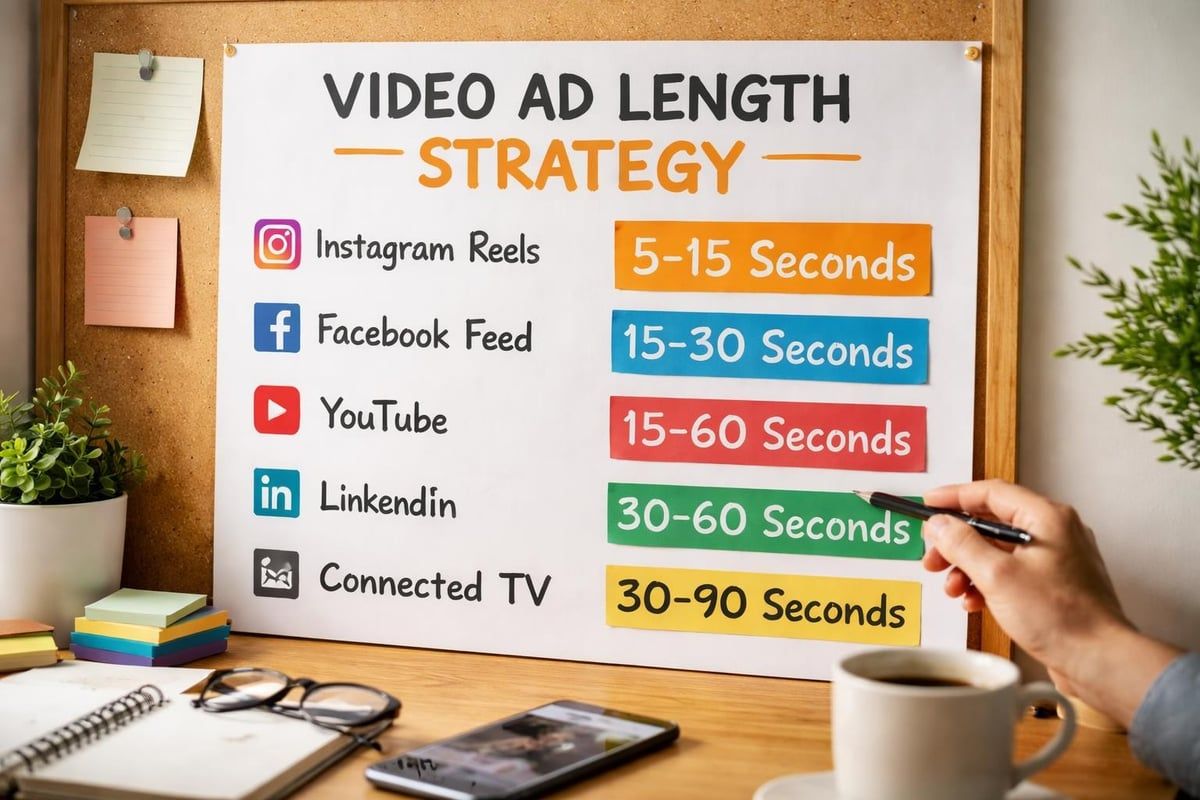
The question "How long should good video ads be?" doesn't have a universal answer. Optimal length depends on platform, audience, and campaign objectives. However, data provides clear guidance for different contexts.
Platform-specific creative planning
Choose placements around the audience you want to reach and the creative they will see. Reels, feed ads and connected TV have different viewing contexts. A reported result from one study or campaign does not establish that a placement will outperform another for your offer.
| Platform | Creative Planning | Key Considerations |
|---|---|---|
| Instagram Reels | Make the opening message clear | Check current placement specifications and safe areas |
| Facebook Feed | Communicate in a mobile viewing context | Plan readable graphics and a clear next step |
| YouTube Pre-roll | Establish the subject and brand early | Check the selected ad format and skip behaviour |
| Address a relevant business need | Use evidence and language the intended buyer understands | |
| Connected TV | Make the brand and message easy to follow | Check broadcaster or platform delivery requirements |
Understanding these platform nuances helps you create good video ads tailored to where your audience actually watches. Corporate video production often requires creating multiple versions of the same core message optimized for different platforms.
The Case for Brevity
While longer formats work for specific objectives like product demonstrations or educational content, good video ads typically embrace brevity. Attention spans continue fragmenting, and production budgets stretch further when you can test multiple short variations rather than investing everything in one long piece.
Short doesn't mean simple, though. Understanding video pricing helps businesses allocate resources appropriately. Well-crafted 15-second ads often require just as much strategic planning and production expertise as longer formats.
Technical Excellence and Production Quality
Good video ads balance creative vision with technical execution. Poor audio, shaky footage, or unprofessional editing undermines even the strongest messaging. In 2026, audiences expect production quality that matches the content they consume from major brands and entertainment platforms.
Essential Production Elements
Professional production encompasses multiple technical disciplines working in harmony. Each element contributes to the overall impact and persuasiveness of your video ads.
Critical production components:
- Cinematography: Proper lighting, composition, and camera movement
- Audio quality: Clear dialogue, appropriate music, sound design
- Color grading: Consistent visual tone that reinforces brand identity
- Editing rhythm: Pacing that matches message urgency and platform norms
- Motion graphics: Text overlays, lower thirds, and animated elements
Music selection and audio production need attention during planning and editing. Keep dialogue intelligible, balance music against speech and check the mix on the devices relevant to the placement. If viewers may watch without sound, make the message understandable through accurate captions and visuals.
Mobile-First Design Principles
Since most video ads are consumed on mobile devices, good video ads are designed with mobile viewing as the priority. This means vertical or square formats, large text that's readable on small screens, and visual storytelling that works without sound.
Testing your video ads on actual mobile devices before launch reveals issues that desktop editing suites miss. Check text readability, color contrast, and whether your call-to-action buttons are large enough for thumb-friendly interaction.
Data-Driven Optimization and Testing
Good video ads improve through systematic testing and refinement. The first version rarely represents peak performance. Smart advertisers treat video creation as an iterative process, using data to guide improvements.
Key Performance Metrics to Track
Different objectives require different success metrics. Brand awareness campaigns focus on reach and view-through rates, while direct response campaigns prioritize click-through rates and conversion metrics.
| Campaign Type | Primary Metrics | Secondary Metrics |
|---|---|---|
| Brand Awareness | Impressions, Reach, View Rate | Brand Lift, Aided Recall |
| Consideration | View-Through Rate, Engagement | Click-Through Rate, Time Watched |
| Conversion | Cost Per Acquisition, ROAS | Click-Through Rate, Conversion Rate |
| Retargeting | Conversion Rate, ROAS | Frequency, Cost Per Click |
Agree on the campaign objective and measurement before launch. Choose metrics that show the next step you want people to take, such as a qualified enquiry or a completed purchase. Views and attention can help explain performance, but they are not interchangeable with revenue.
A/B Testing Variables
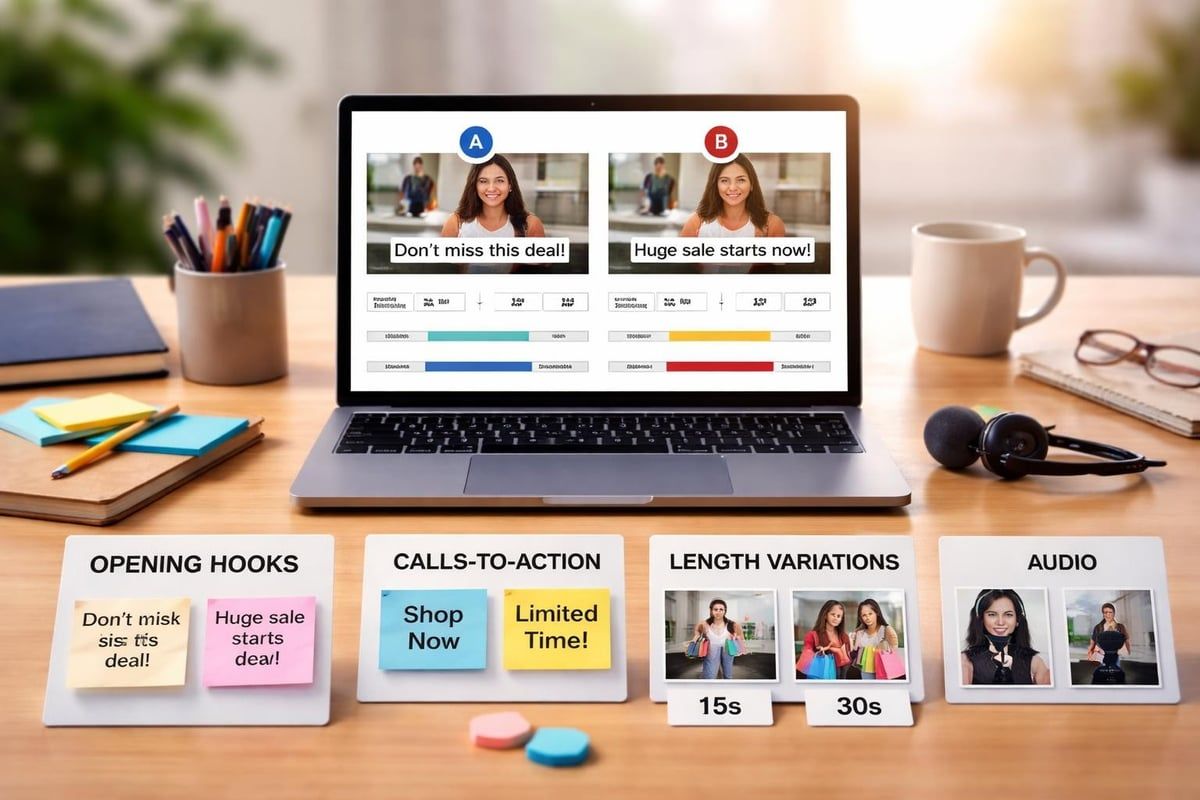
Creating good video ads involves testing different elements to identify what resonates with your specific audience. Rather than testing everything simultaneously, isolate individual variables to understand what drives performance changes.
High-impact elements to test:
- Opening hooks (first 3 seconds)
- Call-to-action phrasing and placement
- Video length variations
- Thumbnail images
- Music tracks and audio styles
- Voice-over talent and delivery
- Visual style (live-action versus animation)
Best practices for successful video campaigns emphasize using remarketing lists and systematically testing different components. This methodical approach produces better results than relying on creative intuition alone.
Advanced Strategies for Scaling Performance
Once you've identified what makes good video ads work for your business, scaling becomes the next challenge. Advanced strategies help you maximize return on investment while maintaining creative quality.
Modular Asset Architecture
Plan a set of reusable creative components when the campaign needs multiple versions. These might include openings, demonstrations, testimonials and end cards. Agree on the combinations and filming requirements before the shoot. Reuse can reduce duplicated work, but costs and output depend on the brief and edit complexity.
Modular video asset architecture allows you to create multiple variations by swapping hooks, middle sections, and call-to-action endings. A single production day can yield dozens of unique video ads when planned strategically.
Platform-Specific Optimization
Good video ads recognize that each platform has unique characteristics, audience expectations, and algorithmic preferences. What works on LinkedIn won't necessarily work on TikTok. Platform-specific optimization means more than just adjusting aspect ratios.
Platform optimization checklist:
- Facebook/Instagram: Sound-off viewing optimization, mobile-first design
- YouTube: Longer storytelling potential, searchable content
- LinkedIn: Professional tone, business value focus
- TikTok: Authentic, trend-aware creative
- Connected TV: Cinematic quality, household viewing context
Cross-platform campaigns require creating variations tailored to each environment rather than using identical content everywhere. This increases production complexity but significantly improves performance.
Retargeting and Sequential Messaging
Good video ads work even better when part of a sequential strategy. Rather than showing the same ad repeatedly, create a narrative arc across multiple touchpoints that moves prospects through your funnel.
Sequential campaigns might introduce your brand with a short awareness ad, follow up with product benefits for those who watched, and close with conversion-focused messaging for engaged viewers. This approach respects the customer journey while maximizing ad spend efficiency.
Memory and Long-Term Brand Building
Different viewing environments can influence attention and recall. When comparing TV and online video, consider the creative, audience and way the study measured its results. Do not assume an attention or memory result proves that one channel will produce more sales for your campaign.
Balancing Performance and Brand Building
The most effective video advertising strategies balance immediate conversion goals with longer-term brand building. Pure performance marketing maximizes short-term returns but may not build sustainable brand value. Pure brand advertising creates awareness but struggles to demonstrate ROI.
Good video ads find the middle ground by incorporating brand elements and emotional storytelling while maintaining clear calls-to-action. This dual-purpose approach serves both immediate and future business objectives.
Creating Memorable Moments
Memorable video ads share common characteristics: surprising twists, emotional resonance, or distinctive creative executions that stand out from generic content. These moments create mental availability, making your brand more likely to come to mind when purchase occasions arise.
Ten best practices for video ads include telling good stories and including compelling ad copy. Story memorability correlates with brand recall, making narrative craft essential even for short-form advertising.
Practical Implementation Framework
Understanding what makes good video ads effective matters little without a framework for implementation. Here's a practical approach for businesses ready to invest in high-performance video advertising.
Pre-Production Planning
Success starts before cameras roll. Thorough pre-production planning ensures your video ads align with business objectives while maximizing production efficiency.
Essential pre-production steps:
- Define clear objectives and success metrics
- Research audience pain points and preferences
- Develop creative brief with key messaging
- Scout locations and talent if needed
- Create detailed shot list and storyboards
- Confirm technical specifications for each platform
- Plan testing variations in advance
Questions to ask before hiring a video production company help ensure alignment between your objectives and production capabilities.
Production Day Efficiency
Professional production teams maximize shooting days by planning shot sequences, preparing backup equipment, and maintaining organized asset management. Good video ads often come from efficiently run productions that capture multiple variations while maintaining creative quality.
Post-Production and Launch
Editing transforms raw footage into persuasive video ads. This phase includes color correction, audio mixing, motion graphics, and multiple rounds of revision. Allow adequate time for post-production, as rushed editing undermines even excellent footage.
Before launch, test your video ads on target devices and platforms to identify technical issues. Check captions for accuracy, verify tracking pixels are properly implemented, and confirm all links direct to intended destinations.
Good video ads start with a useful message, a clear brand presence and a next step that fits the campaign. Plan the creative and the delivery versions, then assess performance with the team responsible for media and measurement. Viva Media produces commercials and social video content for brands and agency partners in Toronto and the Greater Toronto Area. The production scope should make clear who owns distribution, testing and reporting.